Walk into any modern office, hotel room or hospital ward and you will find a small device on the wall that people barely notice. That is usually a compliment. When room control works, nobody talks about it. When it doesn’t, everybody does.
Alledio makes two devices that live in exactly that spot: the OEM Room Unit and the OEM Room Controller. From two metres away, most people cannot tell them apart. That is intentional. The difference is not what the occupant sees, it is what sits behind the wall plate and what the device is expected to do once the room gets warm, stuffy or empty.
This article breaks down where the two products overlap, where they part ways, and how to decide which one fits your project without paying for capability you will never wire up.
What the Two Devices Share
Let’s start with the part that surprises most people: the two products are twins on the surface.
The user interface is identical. Same screen, same layout, same icons, same menu logic. If your maintenance team learns one, they have learned both. That matters more than it sounds. In a building with mixed applications, where a fan coil serves the open office and radiant ceiling panels serve the meeting rooms, you do not want two different training sessions and two different sets of complaints.
The user experience is also identical. Setpoint adjustment, fan control, schedules, widget behaviour, the way the display wakes up when someone walks past. It behaves the same way on both devices, so occupant behaviour stays consistent across the whole floor plan.
Both devices carry Wi-Fi on board, which opens the door to configuration, commissioning and diagnostics without a laptop and a cable in a ceiling void. Both also support remote firmware updates, so a fleet of a few hundred devices does not turn into a few hundred site visits every time a feature improves or a protocol quirk gets fixed.
On the sensing side, both come standard with temperature and humidity. Both can be ordered with an optional CO2 sensor for demand-controlled ventilation, and both can be specified with occupancy detection when the application needs presence-based setback rather than a fixed schedule.
So if your selection criteria are “how it looks, how it feels, how it measures and how it gets updated”, the two products are interchangeable. The decision lives elsewhere.


Where They Actually Differ
The honest summary is this: the Room Unit is a very good interface and sensor; the Room Controller is a very good interface, sensor and control device in one housing.
Think of it as the difference between a cockpit dial and the autopilot. The dial tells the pilot everything and lets them turn things. The autopilot does the flying. Both belong in an aircraft. They are not substitutes for each other.
The Room Unit is designed for buildings where the intelligence already exists somewhere else — a BMS controller in the panel, a plant-room device, a manufacturer’s own fan coil board. In that world, you need a beautiful, reliable, well-connected point of interaction on the wall, and nothing more.
The Room Controller is designed for buildings where you want the intelligence in the room itself, wired directly to the valves, the fan, the damper and the field sensors. Fewer boxes in the ceiling, shorter cable runs, less coordination between trades.
Comparing the Inputs and Outputs
This is where the physical gap is widest, and it is the fastest way to tell whether your project needs one or the other.
The Room Unit has a deliberately minimal terminal set: Modbus and power supply. That is the entire story. It talks, it senses, it displays. It does not switch a valve or drive a fan because it was never asked to. This simplicity is a feature, not a limitation — fewer terminals means faster installation, smaller housing depth and a lower failure surface. And a more attractive price.
The Room Controller carries a genuinely useful I/O set, sized for commercial and residential building applications rather than for a spec sheet contest. The maximum configuration is 3 universal outputs, 2 universal inputs and 1 additional universal point that can be configured as either an input or an output. Every one of those points can be analog or digital, which is what makes the device flexible across very different mechanical systems.
That flexibility is the entire point. A 0-10 V modulating valve, a thermal actuator, a three-speed fan relay, a window contact, a condensate alarm, a remote floor sensor, a dew-point sensor — all of these are handled by the same hardware platform, just configured differently.
Control Logic: Optional Versus Guaranteed
The second real difference is about firmware behaviour rather than terminals.
The Room Unit can be supplied with or without control logic, depending on what the client ecosystems demands. Some companies want a pure interface that simply passes setpoints and readings over Modbus to a master system. Others want the Room Unit to hold some local logic. Both are possible, and it is specified per product version / project demands / manfuacturer requirements.
The Room Controller always comes with control logic, configured for a specific application for one or several use cases. There is no “blank” version, because a controller without a control logic is just a thermostat-shaped paperweight.
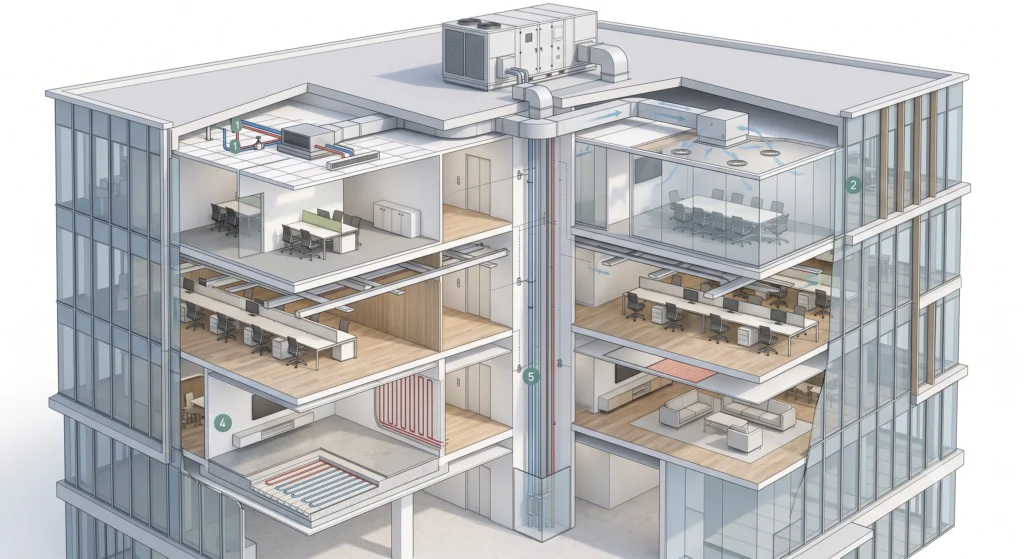
The application is selected according to what actually needs controlling in the room:
- Fan Coil Units — 2-pipe heating, 2-pipe cooling, 2-pipe change-over heating and cooling, and 4-pipe systems.
- AHU air supply — 2-pipe heating, 2-pipe cooling, 2-pipe change-over heating and cooling, 4-pipe, and VAV in master/slave arrangements.
- Chilled beams — including VAV fresh-air supply control driven by temperature, CO2 or VOC.
- Radiant systems — radiator heating, floor heating, floor cooling, ceiling heating, ceiling cooling, wall heating and wall cooling.
- Rooftop Units
That last group is worth pausing on. Radiant systems are slow and unforgiving, and they punish naive control strategies with either overshoot or condensation. Having application-specific logic in the room, close to the sensor and the actuator, is not a luxury there.
Pricing and How the Cost Actually Behaves
The Room Unit sits at the more attractive price point, and that is a direct consequence of the hardware. Two terminals instead of a full I/O block, a simpler board, a simpler test procedure. If your project needs two hundred wall devices and the control already lives in a panel, the savings are meaningful and repeated two hundred times.
The Room Controller is priced according to its configuration. It is not a single fixed SKU with a single fixed price. The number of inputs and outputs you actually specify affects the cost, up to the maximum of three universal outputs, two universal inputs and one universal input-or-output. A simple 2-pipe fan coil with an on/off valve and a three-speed fan does not need to be paid for like a 4-pipe application with a modulating valve and a window contact.
In practice, the most expensive mistake in room control is not choosing the wrong device — it is over-specifying every room to the worst case. Andivi works through the actual use cases per zone and helps land on the combination that covers the mechanical requirement without carrying unused terminals across the whole building.
OEM and White-Label Options
Both devices exist as OEM and white-label products, and that is not an afterthought bolted onto a catalogue item. Manufacturers of fan coil units, air handling units and heat pumps regularly need a room device that carries their brand, their housing colour, their menu wording and their application logic, without funding a full hardware development programme to get there. Andivi handles that end of the work directly: firmware behaviour, display typography, application presets, protocol mapping and documentation can all be tailored, and the same platform can be delivered under a partner’s name across an entire product family. If you are shipping equipment rather than installing it, this is usually the more relevant conversation — the wall device becomes part of your own product line instead of a third-party box your customer has to source separately.

Summary Table
| Criteria | Alledio Room Unit | Alledio Room Controller |
|---|---|---|
| User interface | Identical | Identical |
| User experience | Identical | Identical |
| Wi-Fi | Yes | Yes |
| Remote updates | Yes | Yes |
| Standard sensors | Temperature, humidity | Temperature, humidity |
| Optional sensors | CO2, occupancy detection | CO2, occupancy detection |
| I/O | Modbus and power supply only | Up to 3 universal outputs, 2 universal inputs, 1 universal input or output (analog or digital) |
| Control logic | Optional, on request | Always included, application-specific |
| Applications | Depends on host system | Fan coil, AHU air supply, chilled beams, radiant systems |
| Price position | More attractive, fixed simplicity | Scales with configured I/O count |
| Best fit | Buildings where control already exists elsewhere | Buildings where control should live in the room |
Choosing Between Them
Ask one question before anything else: where does the control logic live in this project?
If the answer is “in the panel, in the plant room, or in the equipment manufacturer’s own board”, the Room Unit is the right device. You get the full interface, the full sensing package and the connectivity, without paying for terminals you will cap off and forget.
If the answer is “it should live in the room, next to the equipment it is controlling”, the Room Controller is the right device. You get the same experience on the wall, plus the I/O and the application logic to actually run the fan coil, the beam, the VAV box or the radiant loop.
Both devices come from the same platform, share the same interface and follow the same update path. That means a building can mix them freely, floor by floor and zone by zone, without the occupants or the facility team ever noticing there are two different products on the wall. Which, going back to where we started, is exactly the point.
When You Need More Outputs: The Alledio MR5
There is a third option that quietly resolves a lot of arguments between electrical and mechanical contractors. The Alledio MR5 is a compact 5-channel RS485 Modbus relay extender that mounts on DIN rail in the panel and expands either a Room Unit or a Room Controller with additional relay outputs. It handles three-speed fan and two-valve control, standalone relay switching, or interlocked curtain and blind control, all switched over the same Modbus line that already runs to the wall device. The architectural logic is clean: keep sensing, the interface and the control strategy in the room, and move the power switching for fans, valves, lighting circuits and shading motors into the panel where 230 V loads belong. Commissioning needs no software at all — Modbus addressing is set with a button and a blink count, which is a small mercy at the end of a long fit-out.

Get in touch!
Tell Andivi what needs controlling in the room, and the right combination of Room Unit, Room Controller and MR5 can be worked out from there.