A Room controller for rooftop units (RTUs) is more than a wall device with a few settings on a screen. It is the part of the system people actually see, touch, and judge, so it ends up carrying the reputation of the whole HVAC solution in a surprisingly visible way.
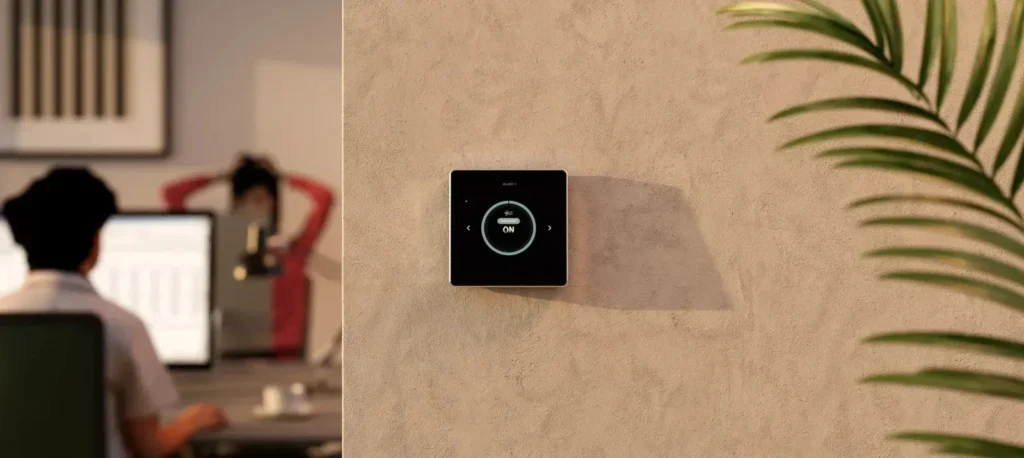
The Alledio OEM Room Controller is built for exactly that role. It combines a sleek design, a touch-based interface, and a firmware-driven platform intended for demanding HVAC integration, including rooftop unit applications. The result feels less like a traditional thermostat and more like a control point shaped by the habits people already know from modern smart devices.
That matters because rooftop units usually hide all the hard work on the roof while leaving users with one visible contact point indoors. If that touchpoint feels awkward, the whole system feels awkward. If it feels polished, the rest of the equipment benefits from that same perception.
Designed to look right and work hardsuper edino kar je je dobro da če je kje beseda bold daje bold tudi v prevodu
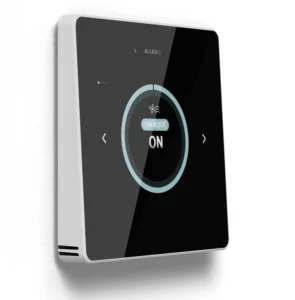
The Alledio controller is designed to fit comfortably into contemporary interiors while still supporting serious HVAC functionality. It is not trying to be flashy for the sake of it; it is trying to be clear, refined, and easy to understand at first glance.
Its interface is one of its strongest qualities. A good room controller should not feel like an instruction manual trapped behind glass. It should feel obvious. Alledio leans into that idea with a clean user experience that helps users adjust settings, read values, and move through menus without friction.
For OEM rooftop unit manufacturers, that is more than a design detail. It is a practical business advantage. The room controller is often the tipping point where engineering meets user expectation, and that small square on the wall can influence how the whole system is perceived.
Sensors that make control more intelligent
A modern Room controller for rooftop units (RTUs) should not simply wait for commands. It should understand the room it is installed in. The Alledio platform includes integrated temperature and humidity sensing, with optional CO2 and presence detection depending on the configuration.
That broadens its role significantly. Temperature and humidity help maintain comfort with more nuance, optional CO2 sensing supports healthier indoor-air strategies, and presence detection can help the system respond more intelligently to occupancy patterns instead of running blindly on assumptions.
There is also a clear user-centric approach in the display behavior, including the brightness-aware logic mentioned in your brief. This helps the controller remain easy to read without becoming visually intrusive, which is a small detail that often makes a large difference in daily use.
I/O flexibility for rooftop applications
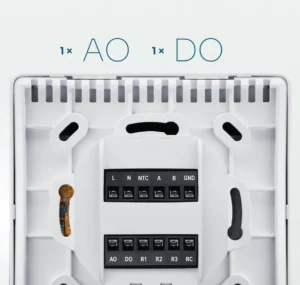
Rooftop units are rarely identical from one manufacturer to the next, so a rigid controller quickly becomes a limitation. Alledio avoids that problem by offering a flexible I/O structure that can adapt to different rooftop system needs.
The controller includes 3 universal outputs that can be configured as analog or digital, plus 1 universal input/output that can be used either way depending on the application. That gives OEMs valuable freedom when matching the controller to the logic of a particular rooftop unit.
On the input side, the controller supports 2 universal inputs that can also be analog or digital, along with the same shared universal I/O point. In simple terms, this allows manufacturers to shape the controller around their equipment instead of reshaping their equipment around the controller.
Scheduling that matches real buildings
Comfort control is not only about what happens now. It is also about what should happen on Monday morning, during lunch breaks, or after everyone has gone home. That is why scheduling matters so much in a well-designed Room controller for rooftop units (RTUs).
The Alledio concept supports 7-day scheduling with at least 6 intervals per day, giving users and building operators enough flexibility to reflect how real spaces are used. Offices, schools, retail sites, and mixed-use buildings all benefit when HVAC operation can follow actual occupancy rhythms rather than a blunt all-day pattern.
Just as importantly, scheduling needs to be usable. A powerful feature hidden behind clumsy navigation is like a sports car in a traffic jam: technically impressive, but not very helpful. A touch-first controller with a clear interface makes those scheduling tools far more likely to be used properly.
Customization and communication options
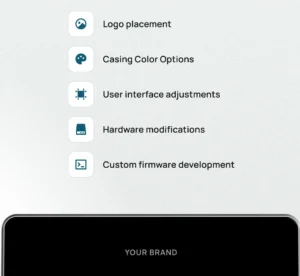
One of the strongest parts of the Alledio offering is its OEM customization potential. This is not just a standard controller with a different label on the front. It is a platform that can be adapted at several levels to suit different products, markets, and integration strategies.
It can operate in Modbus environments and may be configured as Modbus master or Modbus slave, depending on the project requirements. That gives manufacturers flexibility when deciding how the room controller should behave within the larger control architecture. In addition, Andivi can support hard-coded Modbus datapoint lists, manual configuration strategies, and even proprietary protocols when a client needs something more specialized.
Visual customization also matters. Branding colors, logo treatment, and interface styling can be adapted so the controller feels native to the manufacturer’s own product line. There is also the option of glass silver printing with the client’s logo, which adds a physical branding layer that goes beyond software cosmetics.
Engineering flexibility for OEM partners
This is where Alledio becomes especially interesting for manufacturers. It is not merely a finished product; it behaves more like an adaptable OEM platform. Andivi’s broader engineering approach, presented through its OEM services, shows a willingness to move beyond catalogue hardware and into client-specific development.
That flexibility matters because rooftop manufacturers often need more than a standard interface. They may need application-specific firmware behavior, a certain communication logic, or deeper alignment with their own product DNA. This is also where the Customizable room unit interface becomes especially relevant, as it shows how the user experience itself can be adapted to different markets, products, and visual identities.
The same logic carries into the broader idea of an OEM Modbus Controller. When a project requires tailored datapoints, protocol adjustments, or more specialized functionality, the controller platform can be shaped around those needs rather than forcing the OEM to accept a generic compromise.
Since Andivi is flexible with deeper firmware modification, client-specific features can also be developed around the preferred behavior of a manufacturer’s equipment. That creates room for custom fan modes, staging logic, occupancy behavior, alarms, special inputs, or other functions that may define a rooftop product family.
Design as a business signal
In HVAC, good design is not decoration. It is part of the product strategy. The room controller is often the only touchpoint users ever see, which means it shapes the emotional impression of the whole system.
That makes design a commercial tool as much as an aesthetic one. A refined room controller can raise the bar not only for a rooftop-unit manufacturer, but also for a fan coil unit manufacturer or any OEM whose product is technically hidden and operationally judged through the wall interface. Good engineering may win the specification, but good design often wins the memory.
Andivi’s emphasis on product design supports that idea. Your brief notes that Andivi received a Red Dot Design Award in 2026 for one of its projects, which underlines that the company takes design seriously on multiple levels. Even without turning the controller into a showroom object, that mindset shows in the way the product balances usability, appearance, and OEM adaptability.
Related applications across HVAC
The rooftop-unit story also connects neatly to other HVAC applications in the same ecosystem. The same principles behind a Room controller for Fan coil units (FCUs) carry over naturally, where comfort control, interface simplicity, and visual quality are just as important.
That makes the broader Alledio approach useful for manufacturers building a family of products rather than a one-off device. A well-developed controller language can help create consistency across rooftop units, fan coils, and other HVAC applications, which is often valuable both for engineering teams and for end users.
There is also a strong overlap with a Room controller for actuator control. In projects involving valves, dampers, or application-specific control logic, the same configurable I/O structure and firmware flexibility become highly relevant. It is the same platform idea, simply pointed at a different control task.
A stronger OEM control point
The Alledio OEM Room Controller makes a persuasive case for a Room controller for rooftop units (RTUs) that does more than handle basic temperature adjustment. Its strength lies in the combination of integrated sensing, flexible I/O, scheduling capability, communication adaptability, and deep OEM customization.
For manufacturers that want a controller aligned to their rooftop systems, their branding, and their preferred integration logic, this kind of platform is far more useful than a fixed product with hard edges. In the end, the controller is not just a control device. It is the handshake between the user and the system, and that handshake should feel confident, clear, and thoughtfully designed.