Put the NOVOS Touch Room operating Unit and the Alledio Room Operating Unit next to each other and you immediately know you’re dealing with flagship devices. NOVOS Touch is Thermokon’s 4.8″ glass‑front showpiece for room climate, lighting and shading control. The Alledio Room Unit, on the other hand, is a minimalistic, beautifully understated glass panel whose whole personality is “quiet elegance”—while still hiding a very capable, cloud‑ready control platform underneath.
NOVOS Touch makes a statement as a high‑end control surface; Alledio aims to disappear into the architecture, then reappear only when someone needs to interact with it. If a device could whisper “less is more,” it would look like the Alledio Room Unit.
NOVOS Touch and Alledio at a Glance
NOVOS Touch is the flagship of the NOVOS family. It combines a high‑resolution 4.8″ touch screen with a real glass surface and is designed to control room climate, lighting, shading and individual scenes. Up to four sensors can be integrated—temperature, humidity, CO₂ and VOC—so one unit can both sense and operate the room. Different bus variants (Modbus, BACnet, KNX, Casambi) let it slot neatly into conventional building automation environments.
The Alledio Room Unit also brings multi‑domain control (climate, IAQ, fan speed, scenes) but is primarily built as a pretty, flexible OEM platform. It uses a 480×320 touch display hidden behind a thin, flat glass front with a minimal frame and no physical knobs. Connectivity leans modern: Modbus‑RTU, WiFi, MQTT, API support and optional Bluetooth, making it a natural extension of cloud platforms and OEM ecosystems.
Aesthetics and UX: Premium Glass vs. Pure Minimalism
NOVOS Touch wears its technology proudly. The 4.8″ touch screen under real glass dominates the front, with UI elements for climate, lights, blinds and scenes. It can show floor plans, sliders, traffic‑light indicators and trends, giving the user a rich, information‑dense interface. It feels like a compact room HMI: clearly a device, clearly a control hub.
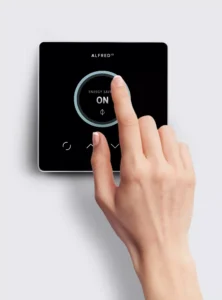
The Alledio Room Unit takes a different road: radically minimalistic, almost gallery‑ready. The front is a single, clean glass pane with a slim bezel and carefully tuned proportions. The on‑screen UI uses restrained iconography, typography and simple shapes, so the panel reads more like part of the wall composition than a gadget. Because everything is soft‑defined in firmware, OEMs can keep the home screen to only the essentials—perhaps just a temperature, mode icon and a slider—and still have deeper menus hidden behind a subtle tap. The result is a controller that does not visually dominate the room, yet feels high‑end the moment you touch it.

Integrated Sensors
Both NOVOS Touch and the Alledio Room Unit are fully equipped for comfort and indoor air quality control. NOVOS Touch supports integration of up to four sensors: Temperature, Relative humidity, CO₂, VOC. It can visualize these values with trends and traffic‑light color indications, making it easy to see at a glance whether conditions are good or drifting. This is especially useful in offices, meeting rooms and educational spaces, where occupants need simple feedback rather than technical numbers.
The Alledio Room Unit supports a similar combination of temperature, humidity, VOC and CO₂ (depending on build) but emphasizes what happens with the data after it is measured. Values can be exposed over Modbus, WiFi and MQTT into SCADA systems, cloud dashboards, OEM platforms or analytics engines. In other words, NOVOS Touch is a powerful local operator and visualizer; Alledio is a sensor and control node for both the room and the wider digital ecosystem.
Communication and Integration: Multi‑Bus vs. Cloud‑First
Communication is where the two devices reflect different eras of building control.
NOVOS Touch Room Operating unit supports classic building automation buses:
RS485 Modbus
RS485 BACnet MS/TP
KNX variants
Casambi variants in the wider family for wireless lighting
This breadth makes it ideal in projects where consultants specify one of these protocols and everything is orchestrated by a traditional BMS or KNX/Casambi system. NOVOS Touch becomes just another, albeit premium, node on that bus.
The Alledio Room Unit starts with RS485 Modbus‑RTU (Client or Server) to integrate into controllers and BMS, and then steps firmly into IP and IoT:
WiFi for IP network access
MQTT as a lightweight channel into IoT/back‑end platforms
API support for integration with OEM apps, dashboards and third‑party services
Optional Bluetooth as an extra IIoT interface or diagnostics channel
Where NOVOS Touch is at home in fieldbus‑centric architectures, the Alledio Room Unit is built to live comfortably in cloud‑centric and service‑centric ones—think fleets of devices monitored, updated and orchestrated from a central platform.
Display, Interaction and Daily Use
For everyday use, NOVOS Touch acts like a full‑featured room panel. Users can:
Adjust temperature and fan stages
Switch or dim lights, change color temperature or RGB/RGBW (depending on system)
Move blinds up/down or to specific positions using sliders
Recall scenes (for example, “presentation”, “meeting”, “relax”)
View measured values with history and traffic‑light visualization
Its screen real estate and rich UI make it particularly attractive in spaces where advanced control is desirable and a more technical interface is acceptable.
The Alledio Room Unit focuses on clarity and custom fit. Its touch UI can:
Provide simple, guest‑friendly controls (temperature, fan, on/off, mode) in hotels or apartments
Offer more advanced multi‑page menus in offices or OEM equipment applications
Integrate extra widgets for scenes, timers, blinds or lighting when firmware is extended
Because there are no physical controls, the Alledio interface can evolve purely in software. That means OEMs can start with a simple set of controls and, over time, enrich the UI as they add features—without changing the physical product or disturbing the minimal aesthetic.
Connectivity, Updates and Lifecycle
In terms of long‑term lifecycle, NOVOS Touch follows the classic model: devices are configured and updated primarily via bus and dedicated tools, often at commissioning or during major upgrades. It fits neatly into well‑defined KNX/BACnet/Modbus infrastructures.
The Alledio Room Unit treats the device more like a connected appliance:
Once on WiFi, it can receive over‑the‑air (OTA) firmware updates, so bug fixes and new features do not require site visits.
Using MQTT and APIs, fleets of devices can be integrated into cloud dashboards and monitoring platforms.
OEMs can coordinate firmware rollouts, feature flags and configuration templates across thousands of units.
This is especially compelling when the room unit is considered a long‑lived endpoint in a digital product strategy—not just a static box on the wall, but something that keeps improving with software.
OEM Customization and Brand Experience
NOVOS Touch is an excellent catalog flagship: it looks high‑end, offers multiple bus options, and comes with a rich, predesigned interface for climate, lighting, shading and scenes. Different colors and cover designs allow it to match many interior styles. It is a strong choice for projects where a premium, ready‑made room operating unit is needed with minimal tailoring.
The Alledio Room Unit is deliberately more like a blank, beautiful canvas. Its minimal design is brand‑neutral: no baked‑in iconography on the glass, no fixed labels, no physical controls that dictate how the UX must look. This opens the door for OEMs to:
Add logos and brand signatures on the glass and in the on‑screen interface
Choose color schemes, icon sets and layouts aligned with their products
Define different “personalities” for different target markets using the same hardware
Extend firmware with domain‑specific features and communication options
In practice, NOVOS Touch is ideal for specifiers who want a premium product straight from the catalog. The Alledio Room Unit fits best when the goal is to create a cohesive, branded and minimalistic experience, where the room unit feels like a natural extension of the OEM’s equipment, app and cloud environment.
Summary
| Aspect | NOVOS Touch Room Operating Unit | Alledio Room Operating Unit |
|---|---|---|
| Visual style | 4.8″ high‑resolution touch screen under real glass; clearly a visible room panel | Slim, flat glass front with thin frame; ultra‑minimalistic and discreet on the wall |
| HMI concept | Rich touch UI with floor plans, sliders, traffic lights for IAQ and scenes | 480×320 touch display; fully configurable UI focused on simplicity and elegance |
| Sensors | Up to four integrated: temperature, humidity, CO₂, VOC | Temperature, humidity, VOC and CO₂ options; designed to feed BMS, SCADA and cloud systems |
| Protocols | RS485 Modbus, RS485 BACnet, KNX, Casambi variants | RS485 Modbus‑RTU (Client/Server), WiFi, MQTT, optional Bluetooth; API‑oriented |
| Main functions | Climate, fan, lights, shading, scenes, ECO, visualization with trends and traffic‑light status | Climate and IAQ control, fan and modes, energy‑aware behaviors; scenes, timers, blinds, lights and OEM‑specific features via firmware |
| Configuration | Via bus and vendor tools inside traditional BMS/KNX/Casambi projects | On‑device plus WiFi/MQTT/API; built for fleet deployment and OEM customization |
| Lifecycle & updates | Oriented to classic commissioning and periodic maintenance updates | WiFi + OTA updates, MQTT and APIs; devices treated as updatable nodes in a larger digital platform |
| OEM focus | Premium catalog room operating unit with multiple bus variants | Purpose‑built OEM platform: branding, UI, firmware and connectivity all adaptable to the manufacturer |
 Room operating unit |  OEM Room Unit |
When Does Each Make the Most Sense?
Choose NOVOS Touch when you are delivering a high‑end KNX/BACnet/Modbus project and want a ready‑made, glass‑front room operating unit that can handle climate, lights, shading and scenes with a sophisticated but predefined interface. It is especially appropriate in premium offices, hospitality and institutional buildings where the spec is heavily centered on traditional building‑automation networks.
Choose the Alledio Room Unitwhen you care about minimalistic, beautiful aesthetics and a future‑proof digital strategy. Its quiet glass design fits seamlessly into design‑sensitive interiors—boutique hotels, modern offices, upscale residential projects—while its WiFi, MQTT, Modbus, OTA updates, APIs and OEM‑level customization make it ideal for manufacturers and integrators building their own ecosystem. If the room device should visually melt into the wall while serving as a smart, evolving touchpoint in your connected product story, the Alledio Room Operating Unit is the more compelling choice.
Compare Alledio to other room units
- Thermokon JOY — fan coil room controller versus Alledio Room Controller
- Thermokon Thanos EVO — flagship room unit versus Alledio Room Unit
- NOVOS 7 — NOVOS 7 versus Alledio Room Unit
- Siemens POL824 — Climatix S400 room unit versus Alledio
- Regio RCX — Regio RCX versus Alledio Room Controller