In real HVAC and building automation projects, the first thing that tends to run out is not CPU power or network bandwidth, but relay outputs at exactly the points where you need to switch loads. A 5 Stage Relay Control solves that bottleneck by adding five intelligent, addressable relays on RS485 in a compact DIN‑rail housing. Instead of treating each relay as a dumb on/off contact, you gain structured staged control that fits fan coils, boilers, chillers and electric heating, and you can even use the device as an OEM building block inside your own product line.
For fan coil applications, see our guide to the OEM Room Controller for FCU.
Why relay extenders with 5 Stage Relay Control matter
Modern rooms and zones pack a lot into small spaces: fan coils, reheaters, blinds, lighting, small pumps and dampers. A single “simple” room can easily consume more than half a dozen outputs if you control everything with individual relays. At the same time, most room units and compact controllers are optimised for intelligence and connectivity, not for raw I/O capacity. Once you hit the last onboard relay, any new requirement becomes a hardware problem.
A Modbus relay extender shifts that constraint out to the edge. Instead of dragging every load back to a crowded controller, you mount a slim DIN‑rail module near the fan coil or in the room distribution box. The controller talks to it over RS485 Modbus, while the extender handles the physical switching. The concept of 5 Stage Relay Control takes this further: rather than manually coordinating five separate relays, you work with clear stages that the device manages internally. You think in “stages” of capacity or speed, and the module takes care of energising the correct relay combinations.
How a 5‑channel Modbus RS485 relay module works in practice
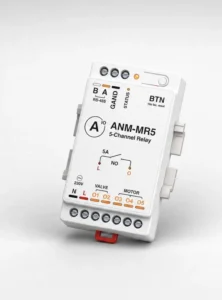
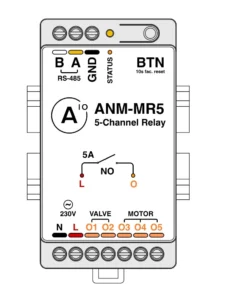
At a technical level, this 5‑channel relay extender acts as a Modbus RTU slave with five onboard electromechanical relays. Each relay is mapped to coils or registers that a Modbus master – a BMS, PLC, gateway, or an Alledio OEM Room Controller – can read and write. Communication runs over RS485 in a standard two‑wire bus. You assign a unique Modbus address, set baud rate and parity, and connect the A/B lines in a daisy‑chain or bus topology. From that point on, the extender behaves like any other Modbus node: it responds to polls, executes write commands and exposes status information for each relay.
For the electrician, wiring feels familiar. The device provides terminals for RS485, a power supply input and then five sets of relay contacts. You wire fan speeds, heater stages, boiler steps or valve circuits exactly as you would on a traditional relay strip, but you no longer tie them directly to controller outputs. Instead, you drive them logically over Modbus.
This architecture lets the controller concentrate on logic and user interface, while the relay extender focuses on safe, repeatable power switching in the field. It is a clean separation of concerns that pays off during design, commissioning and later service.
What 5 Stage Relay Control actually gives you
The real differentiator is 5 Stage Relay Control. Instead of a random assortment of five independent relays, the module can orchestrate them as a sequence of up to five stages. Each stage corresponds to a defined relay pattern and a clear level of output capacity.
In a fan application, these stages could represent different discrete speeds. In a boiler or chiller plant, they might correspond to incremental capacity blocks. For electric heating, stages can represent increasing power levels so you can ramp up instead of jumping straight to full load.
From the controller side, you can treat the stage as a single variable – for example, an integer from 0 to 5 – rather than worrying about exactly which relay needs to be on for each level. The extender ensures that each stage activates the right relays, prevents conflicting states and moves between stages in a defined, predictable manner.
Converting a 0–10 V fan signal into stepped relay control
A very common challenge is the mismatch between modern 0–10 V control outputs and traditional step‑controlled fans or heaters. Many room controllers, including devices like the Alledio OEM Room Controller, expose a 0–10 V output to modulate fan speed or capacity. But the mechanical side may still use three‑speed or multi‑stage AC motors that expect relay contacts, not an analog signal.
With 5 Stage Relay Control, the relay extender can act as the missing bridge. It interprets the 0–10 V signal and maps it into discrete stages: for example, 0–2 V might correspond to stage 0, 2–4 V to stage 1, and so on up to stage 5 at the highest voltage band. Each band drives a predefined relay pattern, giving you stepwise control that feels “analog enough” at room level but remains fully compatible with classic fan coils or staged heaters.
For a room-control architecture that combines a wall device with panel-mounted relay capacity, see the Alledio Room Thermostat.
A room‑level example with 5 Stage Relay Control
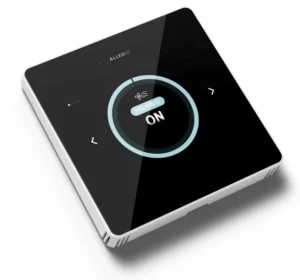
Imagine a hotel room or high‑end apartment with a fan coil unit and optional electric reheating. The designer wants a sleek, networked room controller with a 0–10 V fan output, valve control and Modbus RTU – something in the family of the Alledio OEM Room Controller. On the plant side, though, the fan coil uses discrete speeds and the heater is staged.
By adding a 5‑channel Modbus relay extender and using 5 Stage Relay Control, you turn this into a tidy, repeatable pattern. The room controller sends its 0–10 V signal and operating mode. The relay extender converts that into stages that drive the fan speeds and heater steps in a controlled sequence. From the BMS point of view, each room is a tidy combination of one smart controller plus one smart relay node, with consistent behaviour across the whole building.
This pattern scales very well. You can replicate it across dozens or hundreds of rooms without rewriting logic from scratch. Commissioning engineers know exactly what each stage should do, and maintenance teams deal with familiar hardware and behaviour at every site.
For a comparison of the Alledio Room Controller with another fan coil room controller, see Thermokon JOY.
OEM‑ready: using the extender as part of your own range
Because the device is compact, Modbus‑based and stage‑aware, it is naturally suited for OEM use. Instead of designing your own relay board, handling its firmware, and managing all the corner cases around staged control, you can integrate this relay extender as an OEM module under your own brand or as a tightly aligned partner product.
This helps you shorten development cycles and reduce hardware risk. You can focus on your core strengths – room interfaces, cloud software, configuration tools and overall system design – while relying on a stable, thoroughly used I/O component for relay staging. In many markets, the ability to ship a pre‑validated relay stage module also simplifies support and certification.
From an integration perspective, all you need is to extend your product’s Modbus profile, expose a “stage” parameter in your UI or API, and document the behaviour once. After that, every OEM variant that uses the extender benefits from the same well‑tested 5 Stage Relay Control behaviour.
When a 5‑channel extender with 5 Stage Relay Control beats a bigger controller
It is easy to respond to I/O shortages by jumping to a larger controller, but that quickly raises costs and complexity. You end up with oversized hardware just to cover a few extra relays, and your product portfolio becomes harder to manage and standardise.
A 5‑channel Modbus relay extender with 5 Stage Relay Control offers a cleaner alternative. You keep your controller family lean and consistent, then extend capacity only where the project actually needs it. Panels stay compact, wiring stays local, and your architecture remains modular. As requirements evolve, you can add or reassign relay extenders without touching the core control hardware.
If you are planning a new HVAC or BMS project – or designing an OEM controller line – it is worth considering where 5 Stage Relay Control could simplify your architecture. Used well, it becomes the quiet piece of infrastructure that lets modern, network‑centric strategies coexist with the very physical reality of stepped fans, staged boilers, chillers and electric heating.