In building automation, some products do their job well, and some products quietly redraw the job description. That is the real difference between the Thermokon JOY Fancoil and the Alledio Room Controller.
At first glance, both sit in the same category: wall-mounted room devices designed to support HVAC control. But once you look closer at design, sensing, I/O, firmware flexibility, and OEM potential, the gap becomes clearer. Thermokon JOY is a capable and well-established controller for classic room applications, especially fan coil systems. Alledio, meanwhile, behaves more like a modern room automation platform — one that happens to wear the tidy face of a wall unit.
That difference matters more than ever. Today’s room controller is no longer just a temperature adjuster with a polite display. In better buildings, it has become a bridge between the user, the HVAC system, the BMS, and increasingly, indoor air quality intelligence. Seen from that perspective, these two products are not simply alternatives. They represent two different ways of thinking about room control.
For fan coil projects, see our guide to the OEM Room Controller for FCU.
Design that says more
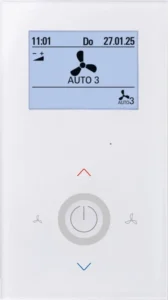
The Thermokon JOY has a clean, practical design. With its glass front, touch-sensitive operating surface, and 2.5-inch display, it looks professional and contemporary enough for hotels, offices, and standard commercial spaces. It is visually neat, easy to place, and clearly built with usability in mind.
Still, JOY stays within familiar thermostat territory. It looks polished, but not especially distinctive. Its design feels functional first, premium second. That is not a flaw, but it does make the product feel more conventional than aspirational.
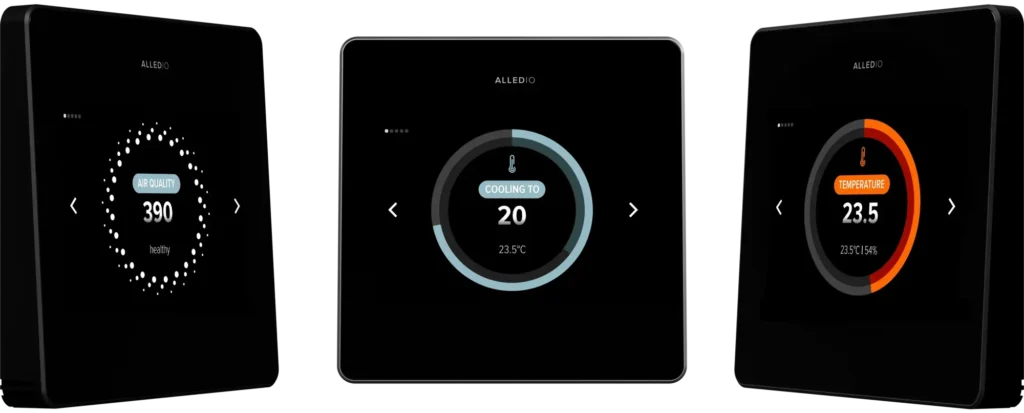
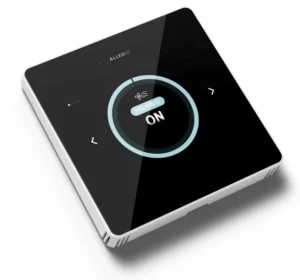
The Alledio Room Controller, by contrast, has a more refined presence. It feels like a product designed with interior architecture in mind, not just controls engineering. Its minimal and OEM-ready appearance gives it a stronger visual fit for projects where the room unit should support the perceived quality of the space, not merely occupy it.
That subtle difference carries weight. A room unit is one of the few building automation devices that occupants interact with directly. It is the face of the system. Thermokon JOY looks competent. Alledio looks composed.
Sensors inside each device: basic control vs richer room intelligence
The Thermokon JOY focuses on the sensing profile expected from a classic fan coil room thermostat. Its core is internal room temperature measurement, and depending on the version, it can also work with external signals such as window contacts, key-card inputs, dew point sensors, or change-over inputs. For straightforward room control, this is often entirely adequate.
That said, JOY’s sensor logic stays rooted in traditional thermal control. It is designed to maintain room comfort and interact with typical occupancy-related or protection-related inputs, but it does not naturally position itself as a richer room intelligence node.
The Alledio Room Controller starts from a broader ambition. In addition to room temperature sensing, it can include humidity sensing and be configured with optional CO₂ and VOC capabilities. This gives it a more rounded role in the room, especially in buildings where comfort is no longer defined by temperature alone.
That added depth matters in modern applications. As ventilation strategy, indoor air quality, and occupant wellbeing move closer to the center of HVAC design, a room device that can sense more becomes more valuable. Alledio is better aligned with that trajectory.
I/O: one controller, two philosophies (the role of the 5-channel relay extender)
The Thermokon JOY is available in multiple versions with analog and digital outputs depending on the model. There are variants aimed at heating/cooling and fan coil applications, plus communication-capable versions for Modbus or BACnet environments. In other words, JOY offers a solid application-shaped toolbox for standard FCU control.
Its I/O structure is useful and purposeful, but it remains tightly tied to the product’s role as a room thermostat. It gives you what you need for its intended application, but it does not naturally extend beyond that box.
The Alledio Room Controller operates with more flexibility. With Modbus communication and 0–10 V output capability, it is already more open in how it can be used with fans, valves, dampers, and broader room-level control logic. The real leap, however, comes when you consider the Alledio 5-Channel Relay Extender.
This extender significantly improves the room-control architecture. Instead of packing every output function into the wall device itself, Alledio allows the room unit to remain clean, compact, and user-facing, while relay switching can be moved to a more suitable electrical location. That creates a more elegant separation between interface and power control.
It is a bit like moving the engine noise behind the curtain while keeping the dashboard beautifully simple. For integrators and OEMs, that can mean better wiring logic, more adaptable installations, and a much cleaner path for scaling functionality.
For projects that need a configurable, OEM-ready room interface, see the Alledio Touch Panel.
Applications: where each device fits best
The Thermokon JOY is strongest in classic room-level HVAC applications. It fits well in hotels, offices, meeting rooms, and similar spaces where the goal is reliable local fan coil control with a familiar user experience. For that role, it is a sensible and low-risk product.
For a closer look at Modbus-based fan coil control, see our guide to the Modbus RTU fan coil unit controller.
The Alledio Room Controller fits more comfortably in projects where room control must do more than handle temperature and fan speed. Because of its broader sensing options, more open I/O logic, and stronger OEM orientation, it works better in advanced HVAC and room automation strategies.
That makes Alledio especially attractive in projects where the room unit is expected to support branding, future customization, broader BMS communication, or richer user interaction. It feels less like a single-purpose controller and more like a long-term building block.
Product variations and platform logic
The JOY family includes several model variations, including heating/cooling, heating/fancoil, and communication-oriented versions. This gives consultants and specifiers a reasonably clear menu. Pick the application, choose the matching model, and move ahead.
The Alledio approach is less catalog-like and more platform-based. Its value lies not just in different versions, but in how the same family can be shaped through firmware behavior, sensing options, communication settings, and expansion accessories. That gives it more flexibility across different OEM products or project types.
This is an important distinction. Thermokon gives you product variants. Alledio gives you a product framework.
Firmware flexibility and OEM adaptation
Firmware is where the philosophical difference between these products becomes more obvious. The Thermokon JOY behaves like a finished controller with a well-defined purpose. That is often ideal in simpler projects because it limits complexity and keeps commissioning straightforward.
The Alledio Room Controller is more adaptable. Its behavior is more strongly shaped by configuration and software logic, which gives manufacturers and system designers more room to align the unit with their own applications. That makes it more suitable for private-label and OEM work, where the room interface often has to serve a bigger strategic role than simple room control.
For projects that value long-term flexibility, this is not a small detail. It is one of the main reasons Alledio feels more future-oriented.
OEM adaptation options
The Thermokon JOY fits well into professional control projects, but it still presents itself primarily as a defined finished product. It is selected, installed, and used largely within the boundaries of the model chosen.
The Alledio Room Controller is much stronger in OEM adaptation. Its branding potential, firmware-driven behavior, sensing flexibility, and compatibility with relay expansion make it better suited to manufacturers or solution providers who want a room unit that can reflect their own identity and system logic.
In simple terms, JOY is a good product you integrate. Alledio is a product you can shape.
Summary table
| Category | Thermokon JOY Fancoil | Alledio Room Controller |
|---|---|---|
| Design | Clean, functional, and visually familiar. | More premium, minimal, and better suited to design-conscious interiors. |
| Sensors | Focused mainly on temperature and standard external control signals. | Broader sensing potential with humidity, and optional CO₂ and VOC. |
| I/Os | Well matched to classic fan coil control applications. | More flexible control logic with better expansion potential. |
| Relay expansion | More self-contained. | Stronger architecture when paired with the 5-channel relay extender. |
| Applications | Best for conventional FCU room control. | Better for advanced room automation and OEM-driven projects. |
| Product logic | Variant-based catalog product. | Platform-style solution with broader adaptability. |
| Firmware flexibility | More fixed-function. | More configurable and future-facing. |
| OEM adaptation | Suitable, but more limited. | Stronger branding and customization potential. |
| Overall judgment | Reliable and practical. | More strategic, elegant, and adaptable. |
|
| |
The Alledio Room Controller, however, is the more compelling choice for projects that think beyond standard thermostat duty. It offers a more polished design language, a richer sensing horizon, more flexible system architecture, and much stronger OEM potential. In a market increasingly shaped by smart buildings, adaptable platforms, and better occupant-facing design, Alledio feels less like a component and more like a strategic asset.
If your next step is choosing a room controller for a conventional fan coil installation, JOY remains a solid option. But if the brief includes flexibility, differentiation, and room for the product to grow with the building or brand, Alledio is the one with the longer runway.
Compare Alledio to other room units
- Thermokon Thanos EVO — flagship room unit versus Alledio Room Unit
- NOVOS Touch — touch room operating unit versus Alledio Room Unit
- NOVOS 7 — NOVOS 7 versus Alledio Room Unit
- Siemens POL824 — Climatix S400 room unit versus Alledio
- Regio RCX — Regio RCX versus Alledio Room Controller