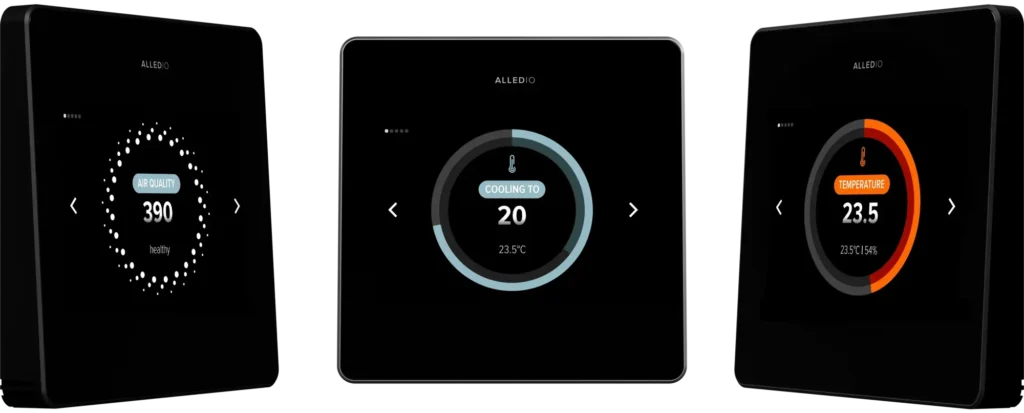
An OEM Room controller for Fan coil units (FCUs) is usually treated as a checkbox item in a specification: “some wall thing with buttons that can turn the fan on.” The Alledio Room Controller takes a very different approach. It behaves less like “some wall thing” and more like a compact smart device—sleek glass front, responsive touch, and an interface that feels closer to a phone than to a traditional thermostat.
Under the clean design sits an OEM-friendly platform for building automation professionals and FCU manufacturers who want their equipment to look and feel as premium as it actually is, as described in more detail in Alledio’s own OEM overview: OEM-friendly. If the fan coil is the engine of comfort, the Alledio controller is the dashboard that finally does it justice.
A Sleek, Smart Front-End for Any FCU
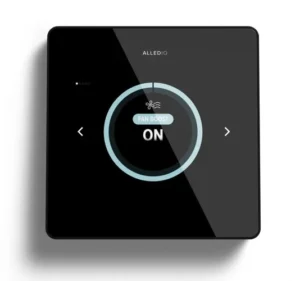
The Alledio Room Controller is designed so it can sit comfortably in a high-end hotel, a modern office, or an upscale residential project without visually shouting “HVAC.” The glass front, minimal frame and responsive touch interface make it look like a small smart display rather than a piece of plantroom hardware that escaped onto the corridor wall.
The UI is deliberately simple and intuitive: clear temperature readouts, obvious fan controls, and scene or mode buttons that can be tailored to the project. Because the controller is OEM, the interface can be aligned with the rest of the building’s visual language—meaning your Room controller for Fan coil units (FCUs) can finally match the quality of your architecture.
Built-In Sensors: More Context, Better Control
Inside the controller you get more than just a temperature probe. The Alledio platform integrates multiple sensors directly into the device:
Temperature for classic comfort control.
Humidity to keep conditions stable and avoid dry or sticky indoor air.
Optional CO₂ for air quality-driven control strategies.
Optional presence detection, which can steer setback strategies when rooms are unoccupied.
A brightness sensor, which can automatically adapt screen brightness so the device is readable in daylight yet unobtrusive at night.
Together, these make the controller a small sensing hub. For a Room controller for Fan coil units (FCUs) this means decision-making can go beyond “what is the air temperature” and start reflecting occupancy patterns and air quality conditions as well.
2‑Pipe FCU – Heating Only

For projects with 2‑pipe Fan coil units used only for heating, the Alledio controller can be configured to drive the system cleanly and efficiently. One analog output can be assigned to control the heating valve, handling modulation in line with your control strategy.
Fan control is flexible:
Use an additional analog output as a 0–10 V signal for an EC fan or an AC fan with 0–10 V input, or
Use the remaining three analog outputs as discrete stages: Stage 1, Stage 2, Stage 3 for a stepped AC fan.
This lets you decide whether you want fully variable fan control or classic three-speed operation—all from the same Room controller for Fan coil units (FCUs) platform.
2‑Pipe FCU – Cooling Only
For cooling-only applications, the mapping is similar—just inverted from a comfort perspective. One analog output is dedicated to the cooling valve, providing modulating control over chilled water to the coil.
Again, the fan can be:
Driven by a 0–10 V analog output for EC or 0–10 V AC fans, or
Controlled by three analog outputs used as staged fan speeds for AC fans.
The advantage is consistency: whether you use heating-only or cooling-only Fan coil units, your Room controller for Fan coil units (FCUs) can be the same hardware platform with different configuration and firmware.
2‑Pipe FCU – Changeover Heating and Cooling
Many systems use 2‑pipe Fan coil units with changeover, switching the same coil between heating and cooling depending on system water temperature or seasonal strategy. The Alledio controller can handle this with a single analog output controlling the coil and logic managing the changeover between heating and cooling modes.
You still retain an additional analog output for:
EC fan or 0–10 V AC fan control, or
Up to three analog outputs dedicated to staged AC fan speeds (Stage 1, Stage 2, Stage 3).
This makes the controller a versatile Room controller for Fan coil units (FCUs) in mixed-mode buildings where you do not want separate devices just for seasonal switching.
4‑Pipe FCU – Separate Heating and Cooling
For more flexible systems with 4‑pipe Fan coil units, the Alledio controller can dedicate two analog outputs:
One for the heating valve,
One for the cooling valve.
Fan control follows the same pattern:
Use another analog output for EC or 0–10 V AC fan control, or
Use the remaining analog outputs for Stage 1 and Stage 2 of an AC fan.
This configuration is ideal where comfort expectations are higher and heating and cooling are available simultaneously. It keeps the Room controller for Fan coil units (FCUs) as the single visible device, while the coil behavior remains fully decoupled.
4‑Pipe FCU – Single Analog Output with Split Range
In some engineering approaches, you may want to drive both heating and cooling with a single analog output, using a split-range control strategy. For example:
5–10 V representing heating demand,
5–0 V representing cooling demand.
The Alledio controller supports such strategies by mapping the control signal range accordingly. You still have another analog output for EC or 0–10 V fan control, or you can divide the remaining three outputs across Stage 1, Stage 2, Stage 3 of an AC fan.
This allows more advanced control philosophies while still standardizing on one Room controller for Fan coil units (FCUs) hardware type.
Scheduling: Because Comfort Also Runs on Time
A good controller does not only react; it plans. The Alledio Room Controller supports scheduling options that can be created directly on the device.
A typical example is a 7‑day schedule where you can define up to six intervals per day. Each interval can carry its own temperature setpoint or mode (comfort, economy, setback). For offices, hotels with predictable occupancy, or residential projects with regular patterns, scheduling allows you to balance comfort against energy use elegantly.
It also makes the Room controller for Fan coil units (FCUs) more autonomous. Even when higher-level systems are present, local scheduling can serve as a robust fallback.

Customisation: Protocols, Modbus Roles, and Branding
Since the Alledio platform is OEM-friendly, configuration flexibility goes deeper than a few setpoints. For integrators and manufacturers, the controller can be tailored at multiple layers:
The Modbus datapoint list can be effectively “hard-coded” or pre-mapped so devices arrive on-site already aligned with project standards; for background, the protocol itself is well documented at Modbus.
The controller can operate as Modbus master or Modbus slave, depending on whether it drives devices or is driven by a supervisory system.
Support for proprietary protocols can be added where justified, allowing the controller to fit into existing ecosystems without gateways.
The branding of the device can be changed: logo placement, color theme within the UI, and even glass silver printing on the front panel with the client’s logo or design accents.
All of this means your Alledio Room Controller does not have to look or behave like anyone else’s, even if it is built on the same base hardware.
Design as a Competitive Advantage for FCU Manufacturers
From the user’s perspective, the FCU is invisible. The only part they see—and interact with—is the controller on the wall. That makes the Room controller for Fan coil units the critical touchpoint that shapes their perception of the entire system.
For Fan coil manufacturers, pairing their units with a well-designed controller is more than an aesthetic decision. It becomes a commercial differentiator. Good design signals engineering care, reduces user friction, and makes the entire solution feel modern.
Andivi has long treated industrial design as part of the engineering problem, not an afterthought. A design-led approach applied to products like the Alledio Room Controller means a well-designed front end can lift the perceived value of an FCU range dramatically, especially in competitive project specifications.
Extending Firmware for Client-Specific FCU Features
Because Andivi develops both hardware and firmware, the platform is not a closed box. For OEM clients or larger integrators, the firmware of the Room controller for Fan coil units can be extended with client-specific features:
Custom fan logic or valve algorithms.
Integration with specific safety routines or local regulations.
Tailored commissioning menus and test modes.
Advanced interaction with building management systems or cloud platforms.
This allows each project—or product line—to express its own requirements without forcing a completely new controller design from scratch.
If you are planning to connect Fan coil units in a way that looks good on the wall and behaves well in the control diagrams, the Alledio Room Controller is built to be that bridge: technically competent for engineers, visually reassuring for users, and flexible enough for OEMs who want their solution to stand out without reinventing the hardware wheel.