In many real HVAC and building automation projects, the limiting factor is not software or network capacity, but something much more basic: you simply run out of relay outputs where you need them most. The room-level version of this, including turning a 0–10 V fan signal into stepped relays, is in 5-stage relay control. A 5‑channel Modbus relay extender is designed to fix exactly that, giving you five addressable relays on RS485 in a compact DIN‑rail housing, with built‑in fan/cool/heat sequence control and 3‑stage step control for fans, boilers, chillers and electric heating. This post explains what such a device does, how it works in practice, and when it makes more sense than replacing your controller with a larger one.
Why Modbus relay extenders matter in modern building automation
Modern buildings are full of loads that still need on/off or step control: fan coil fans, pumps, valves, electric heaters, boilers, chillers, dampers and blinds. Even if your central controller or room unit is powerful on the logic side, its physical I/O is often fixed and limited. Once the last relay is used, any additional demand means redesigning hardware, not just software. A Modbus relay extender shifts this bottleneck. Instead of depending on the controller’s built‑in outputs, you move switching out to a small RS485 node that exposes additional relays as Modbus coils. From the BMS or PLC perspective, it is just another addressable device on the bus, but physically it sits much closer to the loads. This reduces cabling, keeps panels modular and makes it much easier to respond to late project changes or future upgrades. With five relays in one compact device, a 5‑channel extender hits a practical sweet spot. It is large enough to handle a typical room or small zone, but small enough to fit easily into crowded control panels and distribution boxes.
How a 5‑channel Modbus RS485 relay module actually works
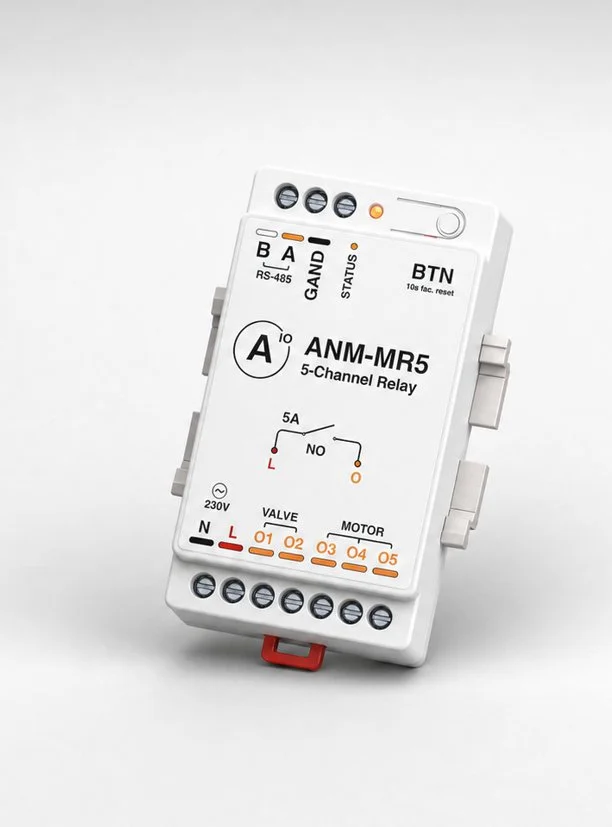
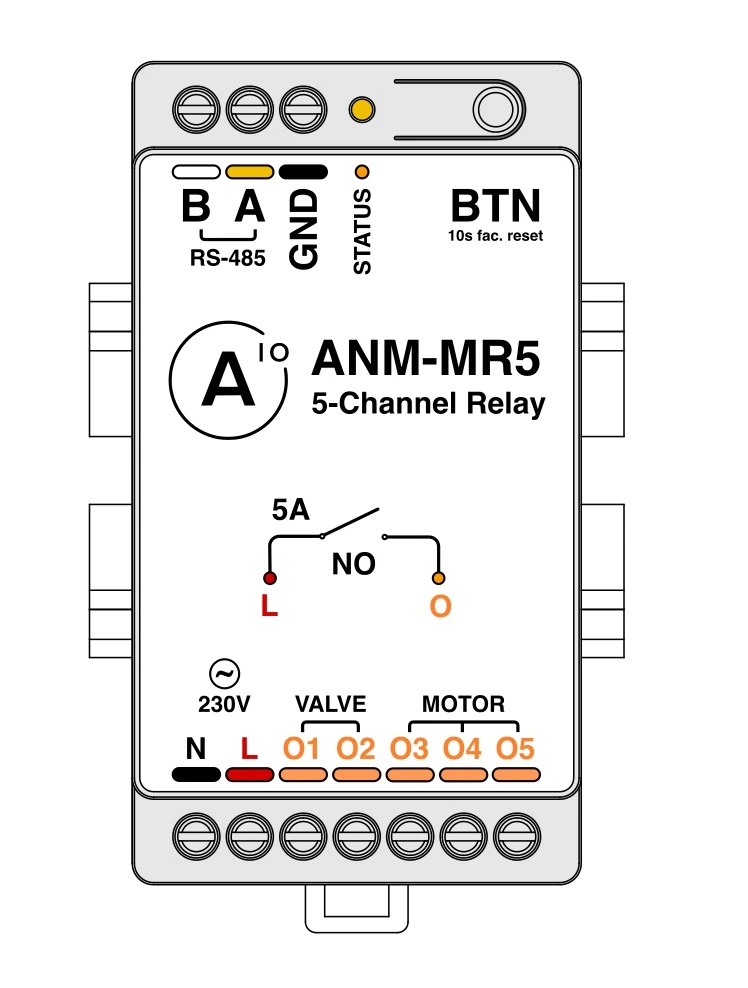
Technically, a 5‑channel Modbus relay extender is a Modbus RTU slave that hosts five electromechanical relays. Each relay is mapped to one or more coils or registers that can be written and read by a Modbus master. The master can be almost anything: a room controller, PLC, gateway, or BMS server. Communication happens over RS485 in a standard two‑wire bus topology. The extender listens on its configured Modbus address and reacts to commands addressed to it. You set its address, baud rate and parity via a button and then integrate it into your existing network just like any other Modbus node.
To the system integrator, the device looks like a compact, remote relay bank. On the wiring side, everything feels familiar. The module offers terminals for the RS485 A/B lines, a power supply input, and then relay outputs with common, normally open and sometimes normally closed contacts. You wire your fan speeds, pumps or heater stages exactly as you would to conventional relays, but you trigger them over Modbus rather than via direct digital outputs from the controller. This separation between logic and I/O is what makes the solution so flexible. The controller focuses on algorithms and data, while the relay extender quietly takes care of switching power where and when it is needed.
Fan / cool / heat sequence control: more than just five relays
The real power of a well‑designed 5‑channel Modbus relay extender is not just the number of relays, but the intelligence behind them. One of the key features is fan/cool/heat sequence control. Instead of toggling individual relays blindly, the module can follow a defined sequence that corresponds to typical HVAC operation. In a fan coil application, for example, the device can use one or more relays to switch between different fan speeds, and other relays to control heating and cooling stages. When your controller requests a particular mode or output level, the module can enforce safe and logical sequences, preventing impossible combinations such as running conflicting speeds or enabling heat and cool at the same time. This sequence logic reduces the amount of code you need to write on the controller side. You can think in terms of “fan mode”, “cooling stage” or “heating stage” instead of micromanaging each relay. It also makes commissioning more robust, because the extender’s internal logic ensures consistent behaviour even if different engineers or integrators work on different parts of the project.
3‑stage step control for fans, boilers, chillers and electric heating
Another important capability is 3‑stage step control. Many HVAC applications do not require or cannot easily use continuous modulation, but they still need more finesse than simple on/off. A 3‑stage sequence offers a good balance between simplicity and comfort. In practice, this means the extender can drive fans, boilers, chillers or electric heaters through three discrete power levels or stages. Your controller can request stage 1, 2 or 3, and the extender will energize the corresponding relay or combination of relays.
This is especially useful when you need to control fans that have three fixed speeds, boilers or chillers that are staged rather than fully modulating, or electric heating circuits that you want to step up gradually instead of dumping full power at once. Because the logic for 3‑stage control lives close to the relays, response times are predictable, and the behaviour remains consistent even if network conditions fluctuate slightly. You also reduce the risk of programming mistakes that would otherwise appear in more complex ladder or function‑block logic on the controller.
Converting a 0–10 V fan signal to 3‑speed relay control
One of the most attractive use‑cases for this type of module is converting a 0–10 V fan signal into three discrete relay outputs. Many room units and HVAC controllers offer 0–10 V fan speed outputs for EC fans or inverters, but in the real world you still often encounter classic three‑speed AC fans in fan coil units. The IO/RM3‑type functionality is designed exactly for this situation. Instead of redesigning the room controller or adding extra hardware, you let the relay extender interpret the 0–10 V signal and translate it into three relay states corresponding to low, medium and high speed.
As the controller modulates the analog output, the extender decides which relay or combination of relays to switch, ensuring clear, repeatable thresholds between speeds, protection against overlapping or conflicting speed selections, and a seamless bridge between modern 0–10 V control logic and traditional step‑controlled motors. For a system integrator, this is extremely convenient. You can keep your preferred room controller hardware, such as an Alledio OEM Room Controller, and its 0–10 V outputs, while still serving projects where the mechanical side has not yet caught up with fully modulating fans.
For a room-control architecture that combines a wall device with panel-mounted relay capacity, see the Alledio Room Thermostat.
A practical room example: 3‑speed fan coil with heating and cooling
Imagine a typical hotel room or residential apartment with a fan coil unit. The designer wants to use a modern room controller that offers a 0–10 V fan speed output, on/off or analog signals for heating and cooling valves, and communication over RS485 Modbus to the BMS. On the mechanical side, however, the fan coil has a three‑speed AC fan and two on/off valves for heating and cooling. Without a relay extender, you would have to rethink the controller choice, add several standalone relays and potentially custom logic to bridge 0–10 V to relay signals. With a 5‑channel Modbus relay extender that supports fan/cool/heat sequence control and 3‑stage step control, the architecture becomes much more elegant. The room controller sends its 0–10 V signal and heating/cooling commands.
For a deeper look at Modbus-based fan coil control, see our guide to the Modbus RTU fan coil unit controller.
The extender converts the analog fan signal into three relay stages for fan speed, and uses the remaining relays to operate the heating and cooling valves in a safe sequence. From the BMS perspective, the room still looks like a clean, single node with clear states; the complexity of the physical switching is hidden inside the extender. This pattern is easy to repeat across many rooms. Each room has the same combination of controller and extender, and the BMS team knows exactly how each unit behaves. That level of modularity is valuable not only during commissioning, but also during long‑term maintenance and future upgrades. If you are working on larger portfolios or OEM solutions, this kind of pattern also aligns nicely with a dedicated platform like Alledio – see www.alledio.com for a broader view of how room units and I/O modules can be combined into scalable solutions.
When a 5‑channel extender is better than “just a bigger controller”
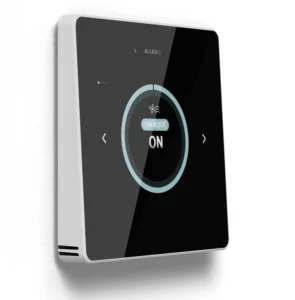
It is tempting to respond to I/O shortages by choosing ever larger controllers, but that approach can quickly become expensive and inflexible. You may end up with oversized hardware in many locations just to cover a handful of extra outputs, or you may lock yourself into a product line that is not ideal for every application. A 5‑channel Modbus relay extender offers a different philosophy. Instead of growing the controller, you grow the edge. Wherever the project needs more relays, you add a small, inexpensive node on RS485 and keep the central logic unchanged. You gain a number of advantages. You can standardise on a smaller, proven controller such as the Alledio OEM Room Controller and extend only where necessary. Panels stay compact and tidy, because you add one narrow DIN‑rail module instead of an additional full‑size controller.
The I/O architecture stays modular, making it easier to split responsibilities between disciplines: HVAC engineers, electricians and BMS programmers can each work within a clear, repeatable pattern. And perhaps most importantly, you retain flexibility. As requirements change, you can add or reassign relay extenders without having to touch the core control hardware. For many HVAC and BMS projects, especially those that involve fan coil units, staged boilers, chillers or electric heaters, a 5‑channel Modbus relay extender with built‑in fan/cool/heat and 3‑stage control is not just a convenience. It is the missing link that lets modern, network‑centric control strategies coexist with the very physical reality of three‑speed fans, staged heat sources and legacy equipment.