The Alledio Room Unit and Alledio Room Thermostat share the same design language and user experience, both are OEM, but they solve a different part of the HVAC-control puzzle. The Room Unit keeps control close to the wall; the Room Thermostat combines the Alledio Room Controller with the DIN-rail-mounted MR5 relay extender, moving mains switching safely into the electrical panel.
For a simple room-control application, the Room Unit can be the neat, self-contained answer. Where a fan coil, valves, lighting or shading require more relay outputs, the Room Thermostat architecture gives installers and OEMs a more scalable route—without turning the wall device into a miniature electrical cabinet.
Same Room Experience, Different Architecture
At the wall, both solutions provide the familiar Alledio experience: a slim touch interface, room sensing, configurable control logic and Modbus communication. The distinction lies behind the wall—or, more precisely, inside the control panel.
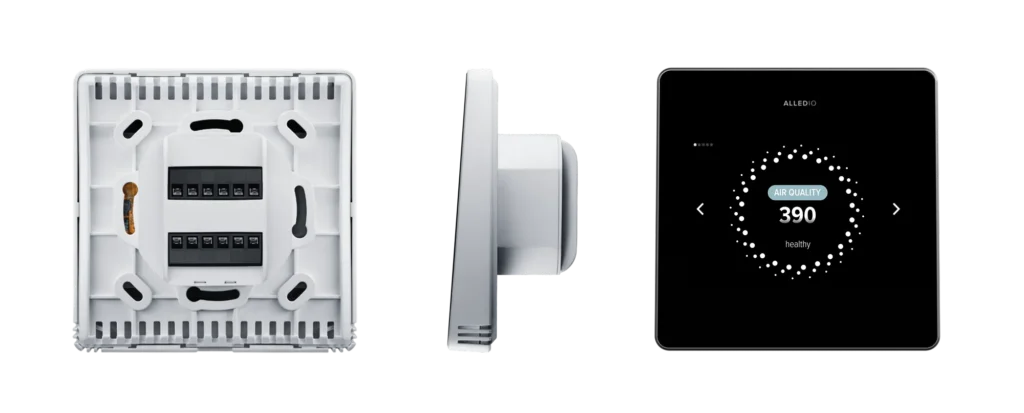
The Alledio Room Unit is the compact all-in-one option. It combines a touch display, integrated temperature and humidity sensing, configurable I/O and RS485 Modbus RTU communication in a 98 × 98 mm wall device. Optional sensors such as CO₂ or VOC can extend it beyond temperature control into indoor-air-quality monitoring.
The Alledio Room Thermostat is not a separate thermostat platform in the usual sense. It is a coordinated system made from the Alledio Room Controller and the Alledio MR5 five-channel Modbus relay extender. The Room Controller remains the intelligent, user-facing device in the room, while the MR5 supplies the additional relay switching capacity from the DIN rail.
Think of it as separating the conductor from the brass section. The wall device coordinates the performance; the panel-mounted extender handles the louder electrical work.

The I/O Difference Matters
The Room Unit is designed for projects where its onboard I/O configuration matches the required application. Its flexible I/O can be configured for common HVAC functions, including sensor inputs, analogue control signals and low-voltage switching requirements. This makes it especially practical for room-level control where the connected equipment is nearby and the electrical design remains relatively straightforward.
The Room Thermostat arrangement becomes more useful when the application needs multiple relay-switched loads. A typical example is a three-speed fan coil unit with two valves: three relays for fan speeds, one for heating, and one for cooling. That already accounts for five output channels before lighting, towel rails, dampers or shading are even part of the conversation.
The MR5 adds five relay channels over the existing RS485 Modbus line. Each relay is rated up to 5 A, allowing the system to switch fan speeds, valves, lighting circuits, fans and motorised curtains or blinds from the panel. It can also operate as a standalone Modbus relay module when the project calls for it.
| Area | Alledio Room Unit | Alledio Room Thermostat: Room Controller + MR5 |
|---|---|---|
| Wall device | Alledio Room Unit | Alledio Room Controller |
| Core approach | Integrated room device with configurable I/O | Distributed system: interface in room, relays in panel / fancoil |
| Relay capacity | Depends on onboard I/O configuration | Five additional DIN-rail relay channels via MR5 |
| Best suited for | Compact HVAC and room-control applications | Fan coils, multi-valve systems, lighting and shading control |
| Power-load location | May be closer to the wall device/application | Electrical panel, where mains switching is easier to manage |
| Communication | RS485 Modbus RTU or Modbus TCP | RS485 Modbus RTU between Room Controller and MR5 |
| Expansion path | Configure the wall device for the application | Add panel-side relay capability without changing the room interface |
Why Put Relays in the Panel?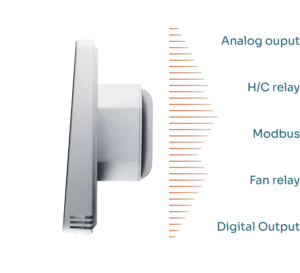
This is not just an I/O-count decision. It is an installation philosophy.
With the Room Thermostat setup, the user interface, sensing and control strategy stay in the room, while 230 V switching is moved into the panel. That can make cable routing cleaner, service access easier and responsibilities between HVAC and electrical trades less ambiguous. Nobody enjoys opening a finished wall installation to investigate a relay issue—especially when the fault is on a mains circuit that belonged in the panel all along.
The MR5 supports three-speed fan and two-valve control, standalone relay switching, and interlocked curtain or blind control. Since it communicates over Modbus, the Room Controller does not need a separate bundle of switching wires running from the wall location to every controlled load.
Commissioning also stays refreshingly practical. The MR5 address can be set with a button and blink-count method, removing the need for additional software just to bring a relay extender onto the bus. That is a modest feature with an outsized appeal during the final, slightly chaotic days of commissioning.
Which One Should You Choose?
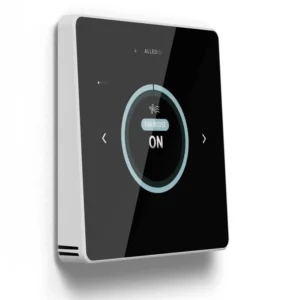
Choose the Alledio Room Unit when the room application is compact, the available onboard I/O covers the requirement, and you want the cleanest possible single-device approach. It is well suited to HVAC equipment where the controller can directly manage the necessary low-voltage signals and where expansion is not a primary requirement.
Choose the Alledio Room Thermostat – the Room Controller paired with MR5 – when relay outputs define the project. Fan coil control is the obvious example, but the same logic applies to hotel rooms, apartments, offices and retrofit projects where room climate, valves, lighting or shading need to be coordinated from one interface.
The important point is that the touchscreen experience does not have to change simply because the output requirement grows. The Room Controller still provides the occupant-facing interface; the MR5 takes care of the panel-side switching. It is a more modular architecture, not a more complicated one.
OEM and White-Label Options
Both the Room Unit and the Room Thermostat platform can be supplied as OEM or white-label solutions. That means the hardware can become part of a manufacturer’s own product family rather than remaining an off-the-shelf controller with someone else’s identity on the glass.
Andivi can tailor firmware behaviour, interface layouts, display typography, housing colours, application presets, Modbus register mapping and product documentation. This matters to manufacturers of fan coil units, air handling units, heat pumps and broader HVAC systems that need a room-control interface aligned with their own equipment and brand. The Alledio platform is designed specifically for that kind of firmware, UI and hardware adaptation.
For OEMs, the choice is therefore not merely “Room Unit or Thermostat?” It is also whether the room device should behave as a generic controller—or as a natural extension of the product the customer already bought from you.
For a broader look at Alledio as a configurable interface platform, read A Customizable Room Unit Interface for Every Application. If you are exploring a branded display for your own equipment range, see The Swiss Army Knife: Introducing Alledio OEM Touch Panel.