A room controller for residential heat pumps does more than let someone turn the heating up or down. It gives the heat pump a clear signal about what is happening where people actually live: in the room.
That sounds obvious. Yet many heat-pump installations still run mainly on water temperature, outdoor temperature, or a basic on/off demand. Those signals matter, but they do not tell the whole story. A well-designed room controller closes that gap. It turns a heat pump from a machine that produces warm water into a system that manages comfort.
For OEMs building residential heat-pump packages, the room controller is also a practical way to create a coherent user experience without developing every interface, sensor, and control logic from zero. This is where Alledio OEM Room Controllers and Room Units fit in.
Residential heat pumps are not one single application
The current residential R290 air-to-water heat-pump market includes several equipment families, typically divided by climate target, output range, electrical supply, and controller level.
At one end are premium cold-climate units. These models are designed to keep useful heating capacity when outdoor temperatures fall, while still delivering high supply-water temperatures. Their main job is often renovation: replacing fossil-fuel boilers in homes with existing radiators, less-than-perfect insulation, or a combination of radiator and underfloor circuits.
These units are commonly available in approximately 4 kW, 6 kW, and 10 kW capacities, with both single-phase and three-phase versions at the upper end. They may support water temperatures up to 75°C, making them more flexible for legacy heating systems and domestic hot-water production. Quiet operation, compact outdoor-unit design, touchscreen control, Wi-Fi connectivity, and app access have become standard expectations rather than exotic extras.
At the other end are standard temperate-climate units, usually intended for homes where winter conditions are less demanding and the heating system works efficiently at lower water temperatures. Typical capacities sit around 6 kW, 8 kW, and 12 kW, again with single-phase and three-phase versions depending on system size and local electrical infrastructure.
The two families may look similar from a distance. Both can heat a home, prepare domestic hot water, and in some cases support cooling. But their control requirements can be different.
A cold-climate renovation system may need tighter coordination between radiators, backup heating, domestic hot water, and high-temperature operating limits. A lower-temperature system in a modern home may focus more on weather compensation, underfloor heating, cooling, zoning, and low-noise operation.
That is exactly why a generic thermostat is often too blunt an instrument. A room controller for residential heat pumps needs to support the logic of the complete system, not just show a temperature number on a wall.
For an example of how Alledio compares with another room-control solution, read our Thermokon JOY comparison.
The bridge between the heat pump and the living room
A heat pump controller is usually responsible for protecting and operating the refrigeration and hydraulic system. It monitors compressor conditions, water temperatures, defrost cycles, pumps, valves, electrical heaters, faults, and safety limits.
A room controller has a different job. It communicates comfort demand.
Think of the heat pump as the engine room of a ship. It needs detailed technical information to keep everything running safely. The room controller is on the bridge, translating what people need into a direction the system can act on.
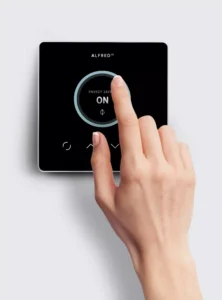
In a typical residential installation, the room controller can provide:
- Room temperature measurement and setting
- Setpoint adjustment for heating and cooling
- Operating-mode selection, such as comfort, eco, away, standby, or frost protection
- Weekly schedules and time programs
- Heating/cooling changeover
- Occupancy or window-contact input
- Fan-coil control where cooling or rapid room response is required
- Local display of alarms, temperatures, and operating status
- Remote connectivity, depending on the OEM system architecture
The Alledio room unit does not need to replace the heat pump’s own controller. In many systems, it should not. Instead, it works as part of a clear control hierarchy.
The heat pump retains responsibility for safe generation of heating or cooling water. The room controller decides whether a zone needs that energy, how much comfort is required, and when the user wants the system to back off.
This approach is especially useful in homes with variable occupancy. A house does not need the same comfort settings at 10h on a weekday as it does at 19h when people return home. A room unit can manage that difference without forcing the homeowner to constantly adjust water-temperature settings hidden in a technical menu.
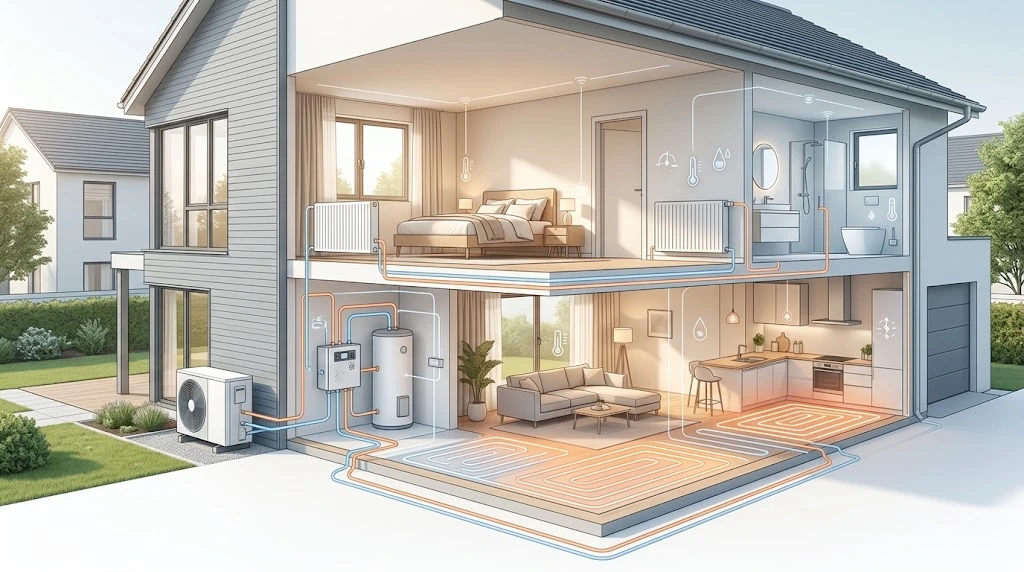
What can be controlled across heat-pump variants?
Whether the application is a compact lower-output unit, a cold-climate renovation system, or a larger three-phase model, the room-control layer can support many of the same functions. The differences are usually in scale and hydraulic complexity.
| Heat-pump application | Typical system requirement | What the room controller can manage |
|---|---|---|
| Small modern home | Low-temperature underfloor heating | Room setpoint, schedule, heating demand, eco mode, floor-temperature limitation |
| Renovated home with radiators | Higher supply-water temperature and variable load | Room demand, setpoint setback, heating enable, boiler/backup coordination signal |
| Heating and cooling home | Underfloor cooling or fan coils | Heating/cooling changeover, cooling setpoint, humidity-related logic, fan speed |
| Home with DHW cylinder | Space heating plus domestic hot water | User mode, comfort schedule, DHW boost request, holiday mode |
| Two-zone property | Radiators downstairs and underfloor heating upstairs | Separate temperature control, zone demand, valve or pump enable, zone-level scheduling |
| Larger three-phase home | Higher load, more hydraulic components | Multi-zone room feedback, system enable, priority logic, status indication |
A room controller can also support setpoint shifting rather than simple on/off control. This is often a better fit for heat pumps, especially in low-temperature systems.
Instead of telling the heat pump “run” or “stop” every few minutes, the controller can request a small adjustment to the water-temperature target based on room conditions. If the room is slightly below target, the controller can ask for a modest increase. If solar gains or cooking have warmed the room, it can reduce demand.
That kind of control is less like slamming a car’s accelerator and brake pedals alternately, and more like maintaining a steady speed on a motorway.
Inputs: what the controller can see
The inputs on a room controller for residential heat pumps determine how much context it has. More context does not automatically mean a better system, but the right inputs can make a major difference.
The most common input is the built-in room-temperature sensor. This is the baseline. It gives the controller a direct measurement of the occupied space.
Additional inputs may include:
- External room-temperature sensor for a better measurement location
- Floor sensor for underfloor-heating protection or floor-comfort control
- Window contact to reduce or stop demand when a window is open
- Occupancy sensor for comfort and setback modes
- Humidity sensor for cooling applications and condensation protection
- Digital input from a heat-pump controller, such as fault, heating enabled, cooling enabled, or DHW priority
- Remote enable input from a building-management system, smart-home gateway, hotel card switch, or energy-management system
- Energy tariff or smart-grid contact, where the system should react to cheaper electricity periods or grid constraints
Residential heat pumps themselves commonly use several inputs beyond room temperature. Typical examples include domestic-hot-water tank temperature, water inlet and outlet temperature, outdoor temperature, water pressure, zone thermostats, smart-grid contacts, and electricity-meter pulse inputs.
The point is not to overload the homeowner with data. It is to give the controller enough information to make sensible decisions quietly in the background.
Outputs: what the controller can command
Outputs are where the room controller becomes useful beyond simple temperature display. Depending on the installation and OEM design, outputs may control or request:
- Heat-pump enable/disable
- Heating or cooling demand
- Zone valve actuators
- Thermal actuators on underfloor-heating manifolds
- Circulation pumps
- Fan-coil fan speeds
- Motorised mixing valves
- DHW boost request
- Backup heater request
- Alarm relay or status indication
- Modbus or other communication-based commands
In a typical air-to-water heat-pump system, external control points may include a domestic-hot-water pump, electric heater, motorised three-way valve, additional water pumps, mixing-valve control, and domestic-hot-water tank sensor.
For a room controller, the right output method depends on the system architecture. A simple installation may use a potential-free relay for heating demand. A more advanced system may use 0–10 V, PWM, triac outputs, relay outputs, or a digital bus such as Modbus or BACnet.
The practical rule is simple: use the room controller to control the room and the zone; use the heat-pump controller to protect and run the heat pump. When both sides are given clear responsibilities, the system is easier to commission and easier to explain.
Alledio OEM Room Controllers and Room Units
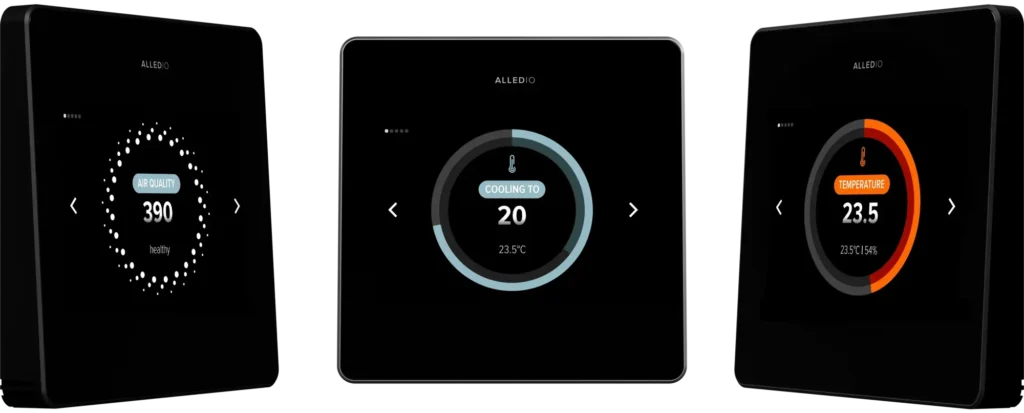
Alledio OEM Room Controllers and Room Units are built for heat-pump manufacturers and system integrators that need a room interface that genuinely belongs to their product range. This is not simply a generic controller with a new logo printed on the front. The goal is to create a room-control product that fits the manufacturer’s system logic, brand language, and intended application.
The controller’s interface, display layout, icons, operating modes, sensor options, and communication protocol can be configured around the heat-pump system. That can mean a straightforward room unit for a compact underfloor-heating installation, or a more advanced controller for homes with multiple zones, fan coils, heating and cooling, domestic hot water, and smart-grid functions.
Integration is equally important. Depending on the architecture, the room controller can communicate with the main heat-pump controller, a gateway, or a building-management system through wired I/O, Modbus, BACnet, or another selected protocol. It can provide practical room-level signals such as heating demand, cooling request, occupancy mode, temperature setpoint changes, window-open status, or fan-coil commands.
For the manufacturer, this creates a more complete product experience. The outdoor unit, hydraulic module, mobile app, and wall controller can feel like parts of one system instead of separate devices forced into the same installation. For the homeowner, it keeps things simple: they see the temperature, choose the preferred comfort level, set a schedule, and leave the complicated hydraulic and compressor logic where it belongs—behind the scenes.
Better heat-pump control starts in the room
Residential heat pumps are becoming more capable, with higher water temperatures, cooling capability, connected services, smart-grid features, and more complex hydraulic configurations. But added capability only helps if the control layer stays understandable.
The room controller is where technical performance meets everyday comfort. It can manage room temperature, schedules, zones, occupancy signals, heating and cooling demand, fan coils, floor protection, and system modes without dragging the user into installer-level settings.
For OEMs, Alledio Room Controllers and Room Units offer a route to create that interface as part of the product—not as an afterthought. The result is a residential heat-pump system that is easier to operate, easier to integrate, and far easier to live with.