ESG building requirements are set to fundamentally transform the real estate sector in the coming years. Increasing regulatory pressure clearly shows that buildings are not exempt from ambitious sustainability targets at both national and EU levels. In both new construction and building operations, compliance with ESG criteria is becoming a key driver of economic success. It is therefore essential to clarify the implications for stakeholders in the real estate industry, identify what is critical for successful ESG management, and define the first steps toward implementation.
ESG for Greater Sustainability in Real Estate
Climate change is already having noticeable effects. In response, the international community legally committed in Paris in 2015 to systematically reduce CO2 emissions. To meet this responsibility, the EU plans to reduce its greenhouse gas emissions by 55% by 2030. In this context, the EU Taxonomy was published last year, clearly defining ESG sustainability criteria for the first time and directing investments toward projects and economic activities that positively impact the environment and climate.
This development has far-reaching implications for companies in the real estate sector. The key takeaway is that both the valuation and operation of buildings must, in the future, align not only with economic factors but also with sustainability criteria to remain competitive. The term “ESG” has become the standard framework, encompassing the dimensions of Environmental (E), Social (S), and Governance (G) to provide a holistic view of sustainability.
ESG criteria are becoming increasingly important in the valuation of companies and assets such as real estate. Due to EU regulations and stricter climate targets for buildings, investors, asset managers, and property managers are increasingly prioritizing ESG-compliant buildings, while tenants are demanding green lease agreements. ESG is therefore no longer merely a compliance issue—it has already triggered a profound transformation.
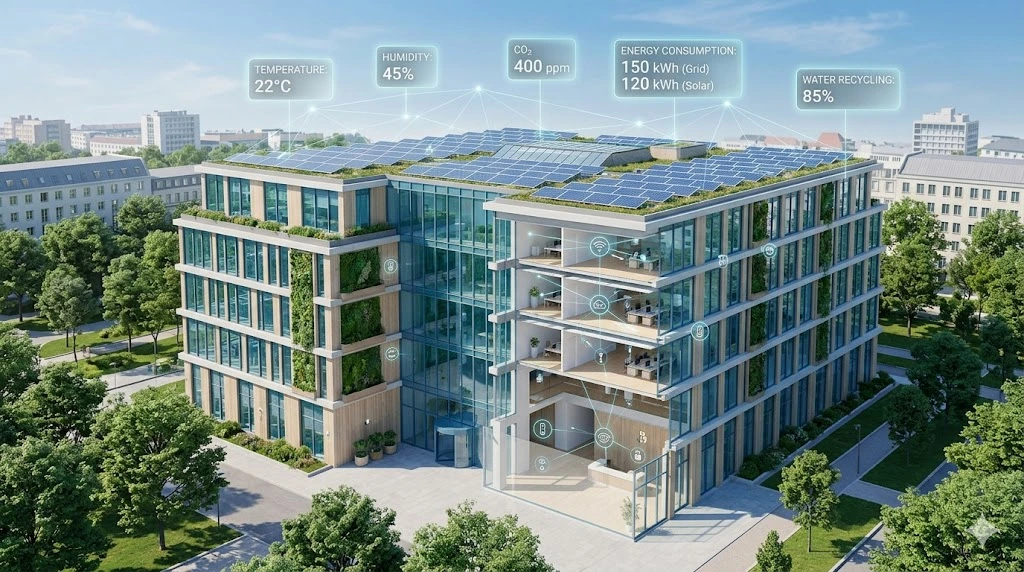
How ESG Criteria Are Transforming Real Estate
In the past two years, the building sector has been the only economic sector to miss its climate targets. This is particularly critical because buildings account for approximately one-third of energy consumption and 40% of CO2 emissions across the EU. It is therefore unsurprising that regulators are placing increasing emphasis on climate protection in buildings.
The focus of the EU Taxonomy is currently on climate mitigation and climate adaptation, placing the “E” (Environmental) dimension clearly at the forefront. The greatest leverage lies in the existing building stock, which represents 98% of all buildings and is often far from meeting the efficiency standards defined for new constructions.
Energy consumption and CO2 emissions in building operations will therefore be the central ESG criteria of this decade, both from a regulatory and economic perspective. Current market data already shows that building value is closely linked to the condition of energy systems and the associated climate risk.
The regular collection, structuring, storage, and analysis of relevant data is thus becoming the key to successful ESG management. In other words, transparency and measurability are fundamental pillars of sustainability in building operations. ESG ratings and certifications will become industry standards in the coming years, and failure to meet them may lead to significant portfolio value erosion.
ESG Management Requires Digitalization
The idea that data is the “new gold” fully applies to the real estate sector. According to industry experts, the sector is ready to embrace digitalization and make the necessary investments and structural changes. The importance of digital tools in achieving climate targets and fulfilling ESG criteria is now widely recognized.
Energy consumption and emissions data play a central role in ESG management. Sustainability and climate protection must be measurable and interpretable. Successful ESG management therefore begins with the digitalization of energy consumption. Only continuous data collection and processing—enabled through Smart Metering—can provide a clear picture of a building’s ESG performance.
In many cases, however, the technical infrastructure required for digitalization still needs to be established, particularly in older buildings. Given the urgency, collaboration with PropTech providers offering scalable and rapidly deployable solutions is highly recommended. The result should be a structured dataset that provides transparency across the portfolio and simplifies ESG reporting.
Modern sensing technologies play a crucial role here. Solutions such as the Alledio BACnet Multi-Sensor enable precise measurement of temperature, humidity, air quality (CO2, VOC), and pressure—providing a reliable data foundation for ESG analysis and optimization.
The next major step in ESG management is the decarbonization of building operations. This requires analyzing collected data and identifying optimization and CO2 reduction potential. According to a study by EY, 87% of real estate professionals consider data analytics the foundation for effective ESG management, yet only about one-third actively use it.
Measures to optimize energy consumption and emissions not only protect the climate but also safeguard asset value and reduce exposure to rising fossil fuel costs and CO2 taxes. Additional benefits include improved operational efficiency and enhanced tenant communication.
Building expertise in data analytics—internally or externally—is therefore another key success factor. Cloud-based solutions and Artificial Intelligence (AI) can support data harmonization, analysis, and visualization, replacing error-prone manual processes.
For decarbonization, insights must ultimately be translated into action. Traditional measures such as upgrading building envelopes or technical systems are often costly and time-consuming. To meet climate targets—requiring roughly a 50% reduction in emissions by 2030—innovative, scalable, and cost-efficient retrofit solutions are essential.
Processes such as heating, cooling, and lighting can be automated using IoT-based systems. These do not necessarily require complex building management systems; lightweight IoT solutions can already deliver significant value and integrate seamlessly with existing infrastructure.
Crucially, all collected data can be transmitted to virtually any platform via industry-standard protocols such as Modbus RS485 (Modbus RTU protocol), BACnet MS/TP, BACnet IP, or MQTT, ensuring interoperability and flexibility across systems.

First Steps in Implementing ESG Criteria
Emissions in building operations arise from lighting, heating, cooling, and ventilation. According to the DENA Building Report 2021, heating accounts for approximately 80% of final energy consumption in residential buildings and 69% in non-residential buildings.
Thermal management therefore represents the single largest lever for climate protection in building operations. The logical first step is to assess the condition of heating systems and begin digitizing heat consumption. Where Smart Metering is not yet in place, it should be implemented as a priority.
Subsequently, efficiency improvements can be systematically introduced to align the building portfolio with decarbonization targets. One effective approach is retrofitting buildings with IoT modules that enable both monitoring and control of systems.
By combining sensor-based data collection—such as through the Alledio Multi-Sensor—with intelligent analytics and automation, operators gain full visibility into consumption patterns and system performance. This enables targeted optimization down to individual system components.
AI-driven control systems can automatically adjust operations based on real-time data, significantly improving efficiency. In many cases, this leads to substantial reductions in both energy costs and CO2 emissions within a short timeframe.
Conclusion: Awareness and Innovation Are Key
ESG requirements will fundamentally reshape the real estate sector by 2030. Regulators are increasingly holding asset and property managers accountable for climate performance while internalizing the costs of CO2 emissions.
Stakeholders must recognize both the transformative impact of ESG and the critical role of digitalization as its foundation. ESG does not end with reporting—the collected data serves as the basis for implementing effective climate measures.
Improving ESG performance across building portfolios helps mitigate risks such as value loss and rising operational costs. At the same time, achieving climate goals requires openness to new approaches.
Traditional renovation methods are often too slow and expensive to be implemented at scale within the available timeframe. In contrast, innovative solutions such as IoT retrofits and AI-based optimization offer fast, scalable, and cost-effective alternatives that can become a central pillar of successful ESG management.
Technology providers such as Andivi support this transition with multi‑sensor IoT hardware and integration services, ensuring that reliable data from the field is available for ESG reporting and continuous optimization.