A pyranometer measures how much solar power actually arrives on a surface, turning invisible irradiance into W/m² values that engineers can log, compare, and automate against. Think of it as a calibrated “sunlight multimeter,” translating a dynamic sky into a clean electrical signal your systems can act on.
Meet ANDWT500 as a pyranometer
A pyranometer is a radiometric instrument that measures global solar irradiance over a hemispherical field of view on a defined plane, typically horizontal. It captures the combined effect of direct beam, diffuse sky, and reflected components, delivering an instantaneous power density reading in W/m². In plain terms, it’s the reference sensor for “how much sun” reaches a surface—fundamental for weather stations, building controls, and solar performance analytics.
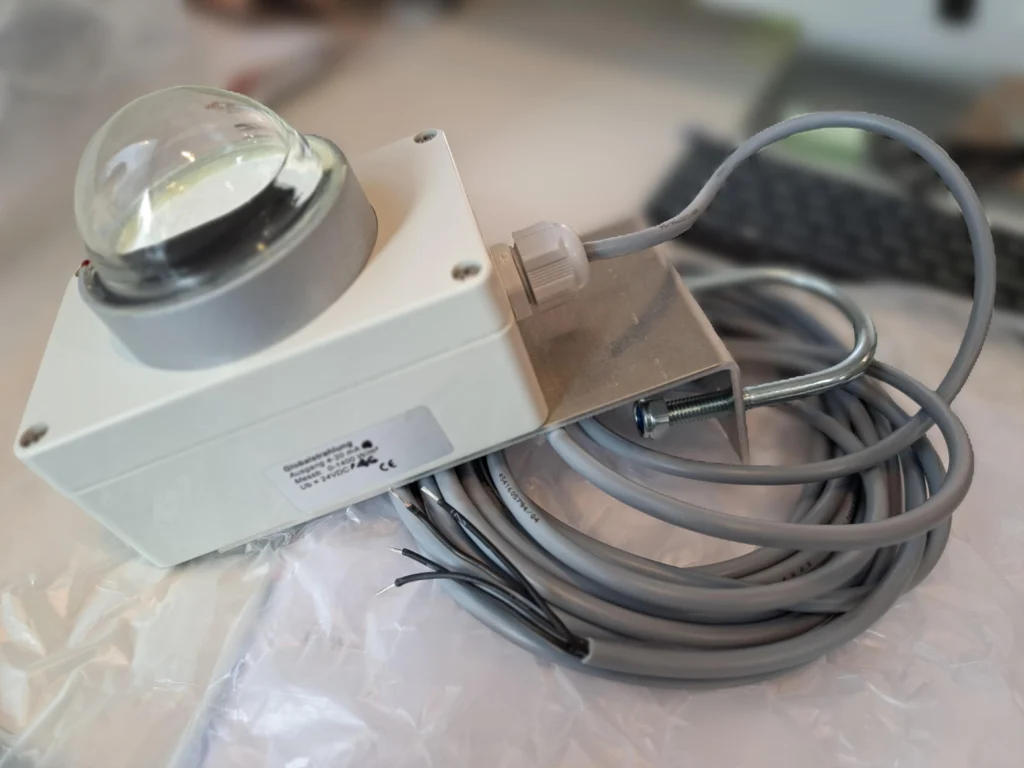
Andivi’s ANDWT500 pyranometer functions as a robust pyranometer for total solar irradiance on a horizontal plane, providing standardized outputs (0–10 V or 4–20 mA) and selectable measuring ranges, making it straightforward to pair with PLCs, BMS, and data loggers. The unit’s outdoor‑ready design—with IP65 protection, a yellowing‑resistant dome, and a practical ±5% tolerance—prioritizes stability in real‑world environments where UV, dust, and temperature swings are routine.
The ANDWT500’s IP65 housing, UV‑resistant dome, and straightforward analog outputs are engineered for predictable operation and quick commissioning. A practical ±5% tolerance and documented wiring simplify integration, while routine cleaning and periodic verification keep measurements stable month after month. In short: dependable hardware, predictable behavior, and low‑friction data acquisition.

What “global irradiance” really measures
Global irradiance is the vector sum of direct (from the sun’s disk), diffuse (scattered by the atmosphere), and reflected (bounced off surroundings) light arriving at the sensor’s plane. The atmosphere acts like a variable optical filter—cloud cover, humidity, aerosols/transmissivity, altitude, and surface geometry modulate the total, so two clear days can still yield different readings. The
ANDWT500 employs a calibrated black‑and‑white sensing surface: by absorbing and reflecting differently, it converts radiative flux into a proportional electrical output—like weighing sunshine on a precision scale. The unit W/m² (watts per square meter) is instantaneous power per unit area; it tells you how many joules per second land on each square meter.
Choosing the right measuring range
0…1000 W/m²: Suited to temperate regions, indoor daylight studies, and conservative building applications where saturation is unlikely and resolution across the routine operating band matters.
0…1200 W/m²: A balanced choice for mid‑latitude sites and general meteorology, handling frequent sunny peaks beyond 1000 W/m² without sacrificing sensitivity in typical conditions.
0…1600 W/m²: The “headroom” option for high‑insolation locations, high‑altitude stations, reflective environments, and research programs where occasional extremes carry diagnostic value.
Use Cases
Pyranometers underpin three core domains—meteorology, building automation, and industrial energy—by converting real‑time sunlight into actionable W/m² data across each workflow. In weather and climate, meteorological stations use them to quantify cloudiness and atmospheric transmissivity, validate model outputs, and track seasonal and interannual variability with ground truth; paired with temperature, humidity, and wind, irradiance closes the surface energy balance forecasters and climatologists depend on.
In building automation, a pyranometer gives Building Management System (BMS) a live solar input for dynamic blind control, solar‑adaptive setpoints, and daylight harvesting that preserves comfort—preventing overheated zones and underlit interiors—while facilities teams use the data to verify envelope performance and tune expectations to local climate. In industry and energy, irradiance normalizes performance ratios for PV assets, flags soiling and shading in operations, and schedules processes that rely on solar windows; for test rigs and environmental chambers, precise W/m² becomes the control variable that makes experiments repeatable and diagnostics trustworthy.
Why the black‑and‑white surface matters
The black‑and‑white top surface in the ANDWT500 behaves like a two‑channel thermal comparator—black absorbs broadly, white reflects—producing a differential that is linearly correlated with global irradiance. This architecture is mechanically simple, optically stable, and electrically clean, turning complex sky conditions into a robust analog signal for SCADA, PLCs, and data loggers. Regular cleaning, firm leveling, and south alignment preserve the cosine response and keep the readings on spec.
Best practices at a glance
Mount horizontally with an unobstructed sky view; verify leveling and use the alignment mark to ensure consistent geometry and metadata clarity.
Select the measuring range to prevent saturation without sacrificing everyday granularity—1000 for building studies, 1200 for general weather, 1600 for high‑insolation or research.
Maintain a basic service routine: keep the dome clean, check cable integrity and zero drift periodically, and log with timestamps and temperature context for traceability.
If a pyranometer would sharpen your weather station, BMS logic, or energy analytics, Andivi can help specify the right range, output, and mounting for your site and data stack. A brief technical exchange often turns diffuse ideas about sunlight into a precise signal your systems can trust.