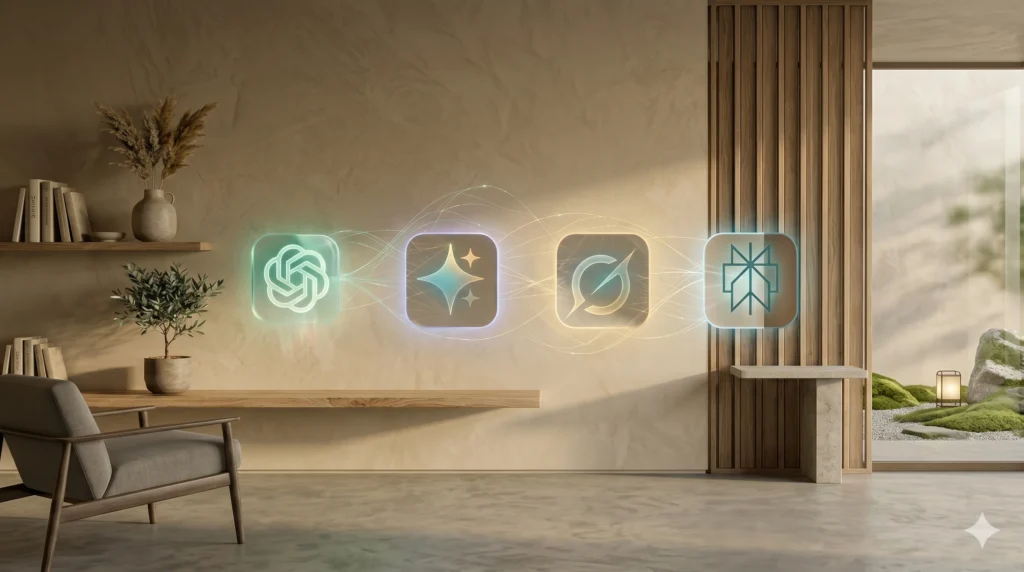
Because the future isn’t just “smart things” – it’s things with actual intelligence. That’s where our vision at Andivi Labs sits: a quiet network of AIoT (Artificial Intelligence of Things) devices on your walls, each one powered by modern AI models like ChatGPT, Gemini, Grok or Perplexity, plus a mature hardware base in the Alledio Room Unit. We’re building a wall‑mounted, minimalist AIoT device for every room – a voice‑first interface that doesn’t spam you with screens and notifications, but quietly focuses on being useful.
What is an AIoT device?
In plain language, an AIoT device is a physical object with sensors and connectivity that also has the reasoning power of AI baked in. Instead of just measuring or switching things on and off, it understands context, language and intent.
Our version of an AIoT device is a wall‑mounted smart unit that listens, talks and controls your surroundings. It taps into advanced language models such as ChatGPT, Gemini, Grok and Perplexity to reason, explain, summarise and help you act. You are not talking to “yet another gadget”; you’re talking to a piece of your building that can think with you.
You say what you need in natural language, and the device routes the task to the most suitable brain in the background. Today that might be ChatGPT for creativity, Perplexity for research‑style answers, Gemini for Google‑connected tasks, or Grok for more real‑time, X‑centric integrations. Tomorrow, it might be models that don’t even exist yet – the point is that you’re not locked into a single AI.
Built on the Alledio Room Unit
This project isn’t starting from a napkin sketch. Our AIoT device is based on the Alledio Room Unit – a beautifully engineered, wall‑mounted room unit originally created for smart building control.
By building on the Alledio Room Unit, we inherit a mature hardware platform that already knows how to live on walls without looking awkward. It brings a clean front surface, solid mounting, and a form factor that feels more like part of the architecture than a gadget someone forgot to tidy away. On top of that, we add LLM intelligence from ChatGPT, Gemini, Grok and Perplexity, transforming a smart room controller into a room‑native AIoT device that can both sense the room and hold a conversation about it.

Designed for walls, not for spec sheets
Most consumer tech behaves like it’s in a permanent talent show: loud lights, animated UIs, and an attention span measured in notifications per minute. Our AIoT (Artificial Intelligence of Things) device deliberately refuses to play that game.
It is wall‑mounted by design, meant to live where you’d expect a thermostat or a light switch. The front is minimalist and calm, with a single, honest mute control that makes privacy physical rather than theoretical. When the microphone is off, you see it. When it listens, you know it. There’s no need to dig through settings just to be left alone.
A small text display on the device shows answers, confirmations or prompts when voice would be too intrusive. You can check a summary of your next meeting, see the weather suggestion for your outfit, or read a quick explanation of a concept without having the room narrated to you. The philosophy is simple: no noise, no clutter, no drama – just intelligence on the wall.
Because our ambition is a device in every room, not just one flagship unit in the living room, the hardware is being designed with accessible pricing in mind. You shouldn’t need a budget meeting to justify adding another device to the hallway. We care about the moment when your home or office stops feeling like “a place with a gadget” and starts feeling like an environment with a shared brain.
That shift only happens when replication is easy – technically, visually and financially.
AIoT at home: when every room gets a brain
One AIoT device is handy. A whole home of them starts to feel like your house developed a nervous system.
In the kitchen, the device becomes your low‑key sous‑chef. You can improvise a meal by asking what you can cook with whatever is left in the fridge, adjust recipes on the fly, or run multiple timers while your hands are busy. Instead of juggling your phone with olive‑oil fingers, you talk to the wall and get structured, sensible help back.
In the living room, the AIoT device acts as your calm layer of intelligence. It can summarise the day’s news without emotional clickbait, help you draft a message to your landlord about the heating that sounds firm but not hostile, or suggest a movie that both you and your partner are statistically likely to enjoy. You’re not wrestling between apps and remotes; you’re having a brief conversation with the room.
In the kids’ room, the same infrastructure turns into a curiosity engine with guardrails. Children can ask it to explain volcanoes “like I’m eight”, ask for a bedtime story rewritten as a space adventure, or get step‑by‑step help with homework without being handed a distraction‑heavy tablet. The AI is on the wall, not in their hands, which is a subtle but important distinction.
In the bedroom, the device shifts into a quieter, more reflective assistant. It can summarise your day into a few bullet points, highlight tomorrow’s top three priorities, guide you through a short wind‑down routine, or quietly set alarms and “I’ll answer tomorrow” replies without dragging you into late‑night scrolling. The goal here is to close mental tabs, not open new ones.
Even the hallway or entrance benefits from an AIoT device. A quick question as you put on your shoes – “Will I need an umbrella for the next few hours?”, “What’s traffic like on my usual route?”, “Remind me what my first meeting is about” – turns the threshold into a tiny decision checkpoint, helping you leave the house prepared rather than guessing.
AIoT at the office: ambient intelligence, not just sensors
In offices, IoT is already everywhere – motion detectors, temperature sensors, presence sensors – but most of it just silently feeds dashboards that only a few people look at. An AIoT device closes that loop by making the building actually talk back.
In meeting rooms, a wall‑mounted AIoT device can, with everyone’s consent, transcribe discussions, extract action items, and present a compact summary at the end of the session. Asking it to “summarise the last half hour and list what each person needs to do” turns a foggy meeting into clear next steps and makes the room itself the keeper of institutional memory.
In focus areas, the device is less about sensors and more about cleaning up cognitive clutter. You can dictate rough notes and have them turned into a coherent project brief, ask for a tense email to be softened without losing clarity, or get a long report condensed into something you can actually read before your next call. Your brain stays on deep work while the AI handles formatting, summarising and rephrasing.
In open office spaces, the AIoT device becomes a shared operational brain. Anyone can ask for a one‑sentence sprint status, a short summary of yesterday’s support themes, or a standup update generated from a few messy bullet points. Instead of ten people opening ten AI tabs, the room provides a single, shared point of intelligence everyone can query.
In creative spaces, the same hardware becomes a brainstorming partner. Teams can ask for unconventional campaign ideas, have specific ones refined under real constraints, or explore alternative taglines in different tones. The whiteboard holds shapes and arrows; the AIoT (Artificial Intelligence of Things) device supplies variation, language and structure on demand.
The result is a workspace where intelligence feels like part of the interior, not something trapped inside individual laptops.

Why accessibility matters for AIoT
The real magic of an AIoT device doesn’t happen at device number one – it happens at devices two, five and ten. As you add units, your environment gains spatial context: which room you’re in, what you’re probably doing there, and which kind of help makes sense in that context. Your building starts to feel less like a collection of rooms and more like a distributed intelligence that happens to have walls.
To make that a reality, an AIoT device has to be beautiful and robust, but also financially scalable. If every additional room feels like buying a luxury gadget, you’ll stop after one. Our goal is the opposite: a device you can justify for the kitchen, the kids’ room, the corridor and the office without hesitation.
That’s why the combination of the Alledio Room Unit hardware foundation with flexible AI brains like ChatGPT, Gemini, Grok and Perplexity is so powerful: solid, proven physical design with software that can evolve.
Want to be part of this?
At Andivi Labs, this AIoT (Artificial Intelligence of Things) device is currently an internal project, but it’s not a closed garden. We’re building on the Alledio Room Unit, weaving in intelligence from ChatGPT, Gemini, Grok and Perplexity, and we’re very aware that the most interesting use cases will come from people who live and work in real spaces every day.
If you have ideas for new home or office applications, want to explore hardware cooperation or integrations, or are working on IoT, building automation or AI interfaces and see overlap, we’d genuinely like to hear from you. Whether you’re a developer, designer, researcher, hardware manufacturer or simply someone with a sharp concept for how an AIoT device should behave, your perspective could shape what ends up on those walls.
The next meaningful step for AI isn’t another tab in your browser. It’s intelligence embedded into the fabric of buildings – quiet, reliable, wall‑mounted. If you could put a single AIoT device into just one room first, which room would you choose?