Most buildings still treat actuators like obedient but slightly underutilized workers: “here’s a 0–10 V signal, don’t ask questions.” A Room controller for actuator control changes that dynamic. Instead of sending blind commands, it becomes a local brains-and-senses package that knows why it is telling a valve, damper, or actuator to move—and how that decision affects comfort, energy, and system stability.
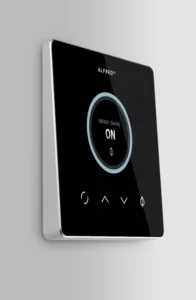
The Alledio Room Controller fits this role surprisingly well. With its sleek glass front, touch interface, built‑in sensors, and flexible I/O, it can act as a Room controller for actuator control in a wide range of projects: from classic VAV actuators in offices, to thermal actuators on manifolds, to small damper motors in hotel rooms or meeting spaces.
Below, we’ll walk through what that looks like in practice—and why your actuators deserve a better boss.
From FCUs to “Anything with an Actuator”
The original use case many know is a Room controller for Fan coil units (FCUs). Underneath, though, the same hardware is essentially a universal control node:
Multiple analog outputs (e.g., 0–10 V) for modulating actuators
Digital outputs that can be used for on/off or staged control
Integrated sensors for temperature, humidity, optional CO₂, and presence
A brightness sensor to keep the display subtle at night
Turn that around, and you get a Room controller for actuator control that can:
Modulate valves on underfloor heating manifolds
Drive dampers in VAV or CAV boxes
Control mixing valves or bypass actuators in small plant sections
Steer actuated radiator valves in more premium spaces
Manage actuated external louvers or façade elements tied to solar gain strategies
Instead of needing one special controller per actuator type, you use a single, adaptable platform and let the configuration and firmware decide which actuator it is managing. That is exactly where the OEM-friendly nature of the platform becomes useful.
Typical Actuator Control Scenarios
Let’s look at how a Room controller for actuator control works in some concrete cases.
1. VAV Damper Control in Offices
In a modern office, each zone often has a VAV box with a damper actuator. The Alledio Room Controller can:
Measure room temperature and CO₂
Use presence detection to distinguish between occupied and unoccupied periods
Send a 0–10 V control signal to the VAV damper actuator
Optionally provide a second analog output to a reheat coil valve in colder climates
The result is local logic that keeps airflow and temperature in check while keeping the central AHU from doing all the micromanaging. When no one is there, the controller can automatically reduce airflow setpoints, saving energy while maintaining a healthy baseline.
2. Radiant Heating Manifold with Thermal Actuators
For underfloor heating or ceiling panels, manifolds often use small thermal actuators that open and close each loop. A Room controller for actuator control can:
Use temperature and floor‑loop feedback to decide which loops should open
Drive multiple on/off or PWM signals to thermal actuators
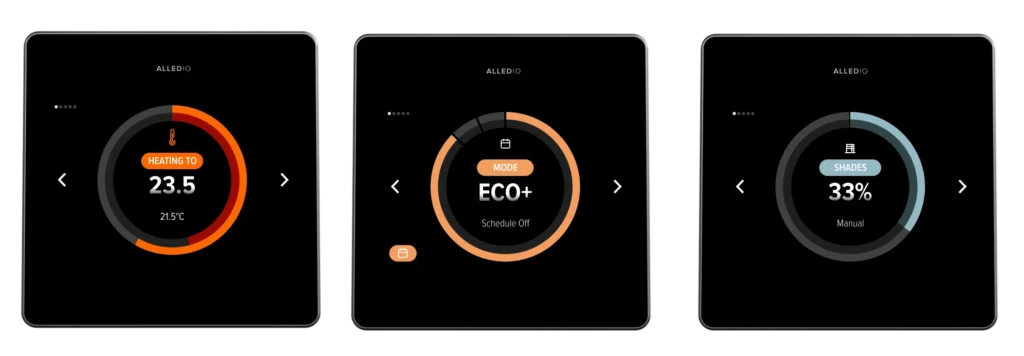
Use the touch UI to set room temperatures, modes such as Comfort or Eco, or time‑based schedules
Provide status for each loop, which is useful when installers or facility managers are debugging cold spots
Now the room controller is not just a pretty thermostat; it is the local loop manager that gives each actuator instructions based on actual room conditions.
3. Small Mixing or 3‑Way Valve Control
In compact mechanical rooms or local mixing stations, you often find 3‑way valves with actuators controlling mixed flow temperature. The controller can:
Monitor supply and return temperatures via external sensors
Use a PID loop to position the actuator via 0–10 V
Expose both the target and actual positions to a BMS over Modbus
Provide a simple local UI for setpoint, overrides, and maintenance modes
Instead of needing a dedicated mini‑PLC, the Room controller for actuator control handles loop logic and user interaction in one device.
4. Façade and Shading Actuators
For buildings with external louvers or motorized shading, actuation can be tied to solar position, brightness, and room temperature. Using the brightness sensor and internal logic, the controller can:
Drive louver actuators via analog or staged signals
Combine solar gain control with glare reduction and comfort
Provide the user with a simple interface: Open, Half, Close, or scenes like Work and Presentation
Here, the controller becomes the local façade brain that balances daylight, glare, and heat.
Why a Room Controller for Actuator Control Beats a Dumb I/O Node
You could, in theory, wire actuators straight into a field I/O module and let the BMS handle everything. So why bother with a Room controller for actuator control at all?
Three reasons stand out:
Local decisions
When latency, robustness, or fallback behavior matter, it is better if the control loop lives close to the actuator. The controller can maintain safe, predictable behavior even if upper‑level networks are temporarily unavailable.Local feedback and interaction
For commissioning, troubleshooting, and end‑user interaction, having a small touchscreen at room level is invaluable. You see real‑time values, actuator outputs, and can test behavior directly without carrying a laptop into every space.Scalable engineering
Using a standard device that can be reconfigured for different actuator roles simplifies both design and maintenance. Teams do not need to learn five different controllers for five slightly different jobs.
Intelligence Plus Integration: Protocols and Roles
In modern building automation, actuators rarely live in isolation. A Room controller for actuator control has to play nicely with others.
That is where fieldbus support and role flexibility come in:
The controller can talk over Modbus to upstream systems or downstream devices.
It can act as Modbus master or Modbus slave, depending on whether it is coordinating other field devices or simply reporting its own status to a BMS.
Because the platform is OEM-friendly, proprietary protocol support can also be introduced where project requirements demand it.
This means the same device can live happily in a classic BMS hierarchy or inside more modern, edge‑oriented architectures where logic is distributed.
Schedules, Scenes, and Smarter Actuation
Actuators do not care about time, but buildings do. A control strategy is much cleaner when the Room controller for actuator control includes scheduling and scene logic.
Some examples:
7‑day schedules with multiple time intervals per day, driving setpoints and modes
Scenes that change multiple actuator outputs at once, for example: Meeting started, adjust VAV damper, close external louvers, tweak setpoint in one move
Setback logic that reduces valve opening or damper positions in unoccupied hours while keeping minimal ventilation or frost protection
By embedding this logic locally, you keep actuators responsive while offloading routine pattern management from the central system.
Customisation: From Data Points to Branding
Since the controller is designed as an OEM-friendly platform, it can be shaped to fit different projects and brands:
Datapoint lists can be fixed, extended, or re‑mapped so the BMS sees exactly the objects it expects
Proprietary sequences or safety routines can be embedded into firmware, making the Room controller for actuator control behave like a native part of your own product line
The visual design is adaptable: logos, color schemes, and even glass printing options can match a manufacturer’s identity or a building’s interior concept
To the end user, the controller looks like your product. To the integrator, it behaves like a well‑structured, documented piece of building automation hardware. For projects that need a unified wall-mounted interface alongside actuator control,Andivi’s Customizable Room Unitoffers the same OEM-friendly customization with an integrated touchscreen display.
Industry Examples Where This Pays Off
A few real‑world patterns where a Room controller for actuator control shines:
Office floor retrofit: replacing old thermostats and pneumatic controls with a flexible controller that can handle VAV dampers, reheat valves, and occupancy‑linked strategies zone by zone
Boutique hotel: using one device per room to manage fan coil valves, fresh air damper actuators, and shading, while giving guests a clean, brand‑aligned interface
Lab or clean zone: locally controlling pressure‑maintaining dampers and modulating valves while reporting critical values back to a supervisory system with accurate feedback and clear alarms
Mixed‑use buildings: where residential, retail, and office spaces each have different actuator strategies, but the engineering team still wants one standard platform
In all these cases, actuators are no longer “dumb endpoints.” They become part of a local micro‑system with their own logic and feedback.

Why It’s Worth a Conversation
Adopting a Room controller for actuator controlis less about adding another gadget and more about reorganizing how you think about local control:
Actuators get a dedicated, sensor‑rich, user-friendly controller
Integrators get a standard platform with enough flexibility for different coil, damper, or valve setups
Building owners get better comfort, better reporting, and better‑looking hardware on the wall
If your current projects still treat actuators as simple voltage consumers at the end of a long control chain, it might be time to give them a smarter local partner. A well-designed Room controller for actuator control turns each zone from “just another endpoint” into a small, intelligent building block—and that is often where genuinely robust, efficient automation starts. Let’s talk!