The Alledio Room Unit is best understood as an OEM Modbus Controller wearing a friendly face. Under the glass, it’s a configurable control platform with a touch display, RS485 Modbus connectivity, and a modular I/O and sensor stack—ready to be shaped into wildly different applications through firmware, UI, and even hardware customization.
This post explains how Non-Recurring Engineering (NRE) requests fit into that story, what “customizable” really means in practice, and why the same device can feel like a thermostat today and an entirely different controller tomorrow.
The “Anything Panel”: A Fully Customizable OEM Modbus Controller Interface
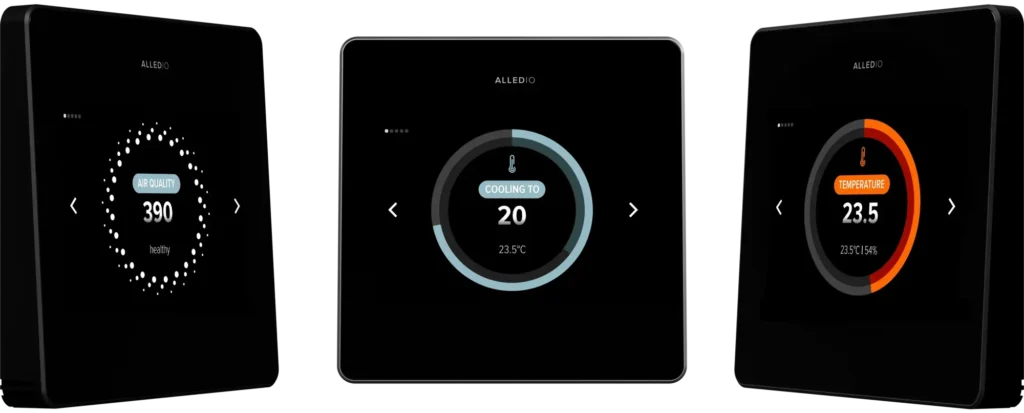
Most controllers come with a personality pre-installed. The Alledio approach is different: the device can ship with an interface you recognize (thermostat-like), but the underlying value is that the user interface can be adapted—layout, widgets, elements, branding, and behavior—to match a specific OEM application.
On the OEM side, customization can include logo placement, branded UI styling (including color scheme alignment), and a UI structure that reflects how your equipment works rather than forcing users to think like a generic controller. This also extends to adding new UI elements and widgets, provided they remain consistent and clear—because a great interface is not the one with the most buttons, but the one that makes the next action obvious.
If the interface is the “front desk,” firmware is the building’s operations team. The OEM offering includes custom firmware development to meet feature requirements, communication support, and UI specifications, including projects that require significant planning, development, and testing.
In addition, the platform supports integration patterns beyond classic fieldbus-only deployments when required, making it easier to align the controller with broader ecosystems.
OEM Modbus Controller Price: Why It Varies (And Why That’s Normal)
With an OEM Modbus Controller, pricing rarely behaves like a simple “one model, one number” product. The overall commercial package typically depends on the hardware capabilities required for a given OEM project.
In practical terms, the variables that tend to affect price include:
The number and type of inputs and outputs needed (digital and analog).
Which integrated sensors are required inside the unit: options commonly discussed include temperature, humidity, CO2, and presence detection.
The connectivity and ecosystem requirements, which can influence firmware scope and qualification needs.
The key idea: OEM pricing follows the same logic as engineering—scope and configuration drive cost, not a one-size-fits-all sticker.
OEM Modbus Controller Setup: Onboarding That Doesn’t Need Extra Apps
A common pain point in controller deployments is configuration that depends on external tools, cables, or “that one laptop” everyone shares. The Alledio Room Controller emphasizes straightforward configuration through its built-in touch display.
That matters because onboarding becomes a guided, on-device experience—useful for installers, service teams, and OEMs who want consistent commissioning steps across projects and sites. It also keeps the “time-to-first-reading” short, which is often the most underrated KPI in building controls.
Firmware and Hardware Customization: Where NRE Comes In
Customization has levels. Some changes are small and repeatable; others require true engineering work. That’s what Non-Recurring Engineering (NRE) is about: one-time effort to research, design, develop, test, and prepare a product enhancement for production-readiness.
Firmware can be customized to meet specific needs, including features, communication support, and UI specifications, and such work is typically treated as a special project requiring significant planning, development, and testing.
Hardware changes can also be part of the scope, including component selection and form-factor adjustments when required, depending on the boundaries of the project.
On the operations side, firmware can be upgraded remotely, and the device can be adapted to match integration expectations beyond “standard thermostat behavior,” depending on the OEM’s requirements.
OEM Modbus Controller Datasheet Highlights (Quick, Useful Specs)
Below is a practical summary of key technical specifications for the Alledio OEM Room Controller (Room Unit):
Power supply: 12V to 24V DC/AC.
Communication: RS485 Modbus RTU, half-duplex, selectable baud rates (9600 to 115200), parity options; RS485 bus load up to 128 devices.
I/O (max configuration): 2 × universal input, 3 × universal output, and 1 × universal input/output.
Integrated sensors: temperature and humidity; optional CO2 and VOC detection.
Measuring ranges (selected): temperature -40°C to +125°C; humidity 0–100%; CO2 400–5000 ppm;
Sensor accuracy (selected): temperature average ±0.2 °C (0–60°C); humidity ±1.8% (10–90% at 25°C); CO2 ±100 ppm ±10% m.v.; pressure 0.5 hPa.
Display: 3.5” LCD, 480 × 320
Ingress protection: IP20.
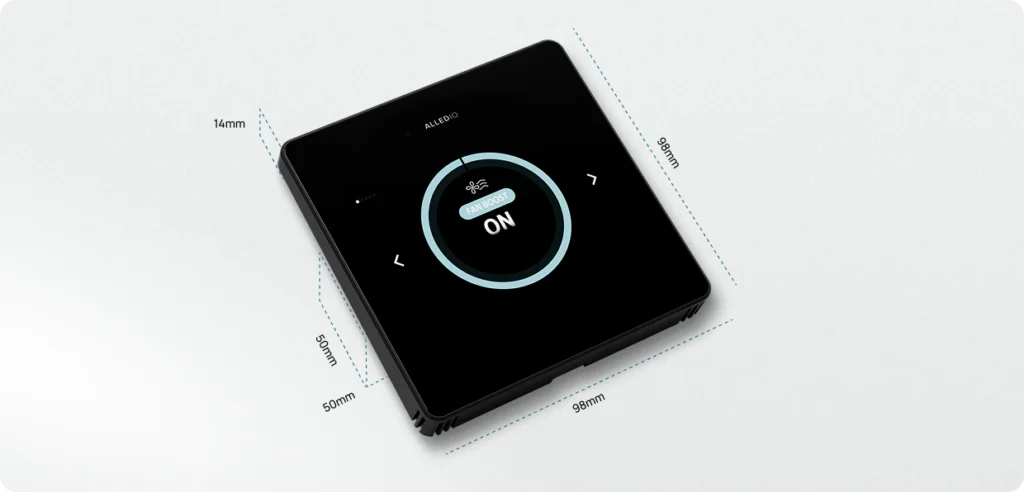
Dimensions / weight: 98 × 98 × 14 mm; 150 g.
Origin / warranty: Slovenia, EU; 1 year.
These specs are the “truth table” behind the flexibility: they show what’s fixed (e.g., footprint) and what’s configurable (I/O, sensors, firmware roles).
The Room Unit as a General-Purpose OEM Modbus Controller
It’s easy to label the device a thermostat because that’s the most familiar UI pattern. But conceptually, if the UI is changed and the logic is adapted, the foundation is a Modbus-connected controller with sensors, I/O, and a human interface—useful wherever an OEM needs a compact control and interaction point.
The controller can operate as a standalone room controller or as part of broader system integration. The point is that it’s a controller-first platform that can be shaped to match HVAC workflows, building automation requirements, or custom equipment logic.
Andivi Firmware Development for OEM Touch Devices

The OEM positioning behind Alledio emphasizes custom firmware development and UI specification work as part of delivering tailored OEM solutions. In practice, this means the engineering focus is not just on hardware supply, but on making the device behave like a native component in an OEM’s ecosystem—whether that’s custom control logic, custom UI flows, additional communication expectations, or specialized commissioning behavior.
Get in Touch & Find Out More
Reaching out is easy: share a few details about your project (use case, required I/O, preferred sensors like temperature, humidity, CO2, or presence, and any UI or branding expectations), and a clear recommendation can be prepared quickly. To make it practical, it helps to include “must-have” requirements and one “nice-to-have” requirements — that small commitment keeps decisions moving and prevents endless option-scrolling. If evaluating options internally, request a small set of samples to test in your real environment; a short pilot is often the fastest way to turn uncertainty into a confident specification.
To explore what the Alledio Room Unit can become as an OEM Modbus Controller—including UI customization, firmware adaptation, and NRE/engineering change possibilities—get in touch here.