For decades, small commercial Air Handling Unit (AHU) systems have followed a familiar script: install a central controller, wire everything into it, configure it, commission it, and hope the whole orchestra plays in tune. It works—but it is often overengineered, expensive, and unnecessarily complex for smaller applications.
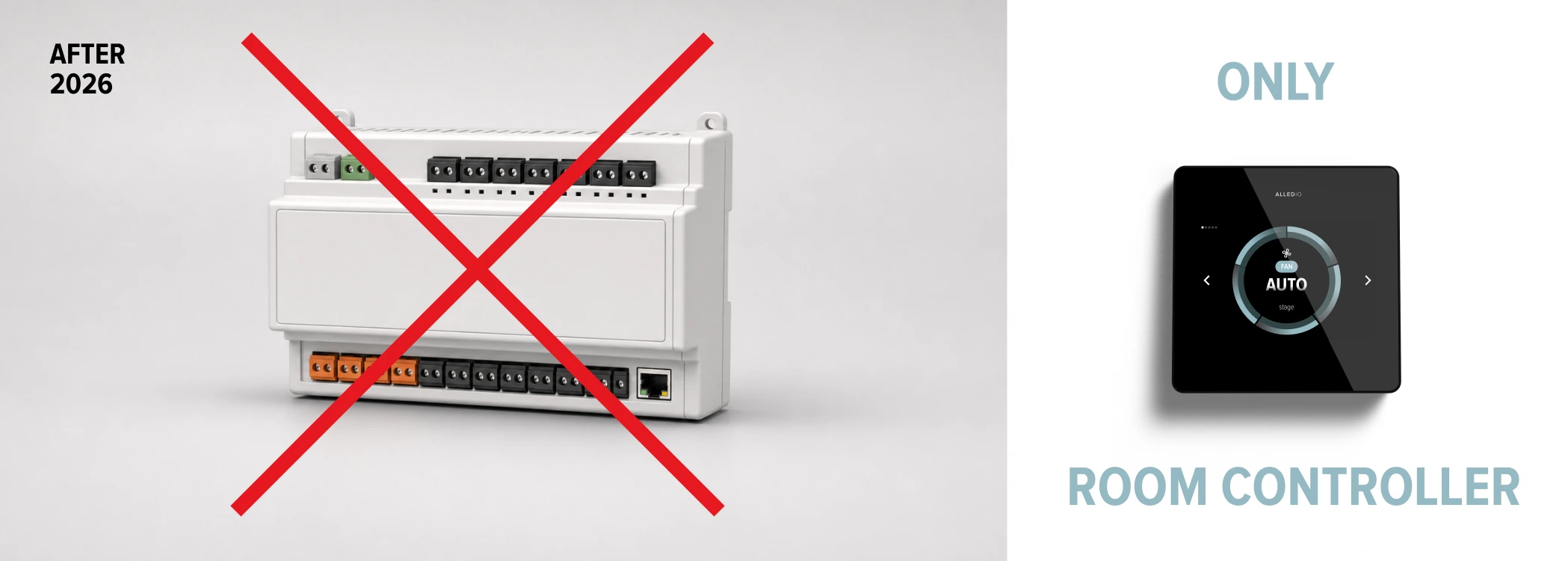
Now, a new approach is quietly reshaping the field: the idea that a room controller replacing the controller in an AHU is not only possible, but in many cases more efficient, more precise, and far more economical.
Let’s unpack why this shift is happening—and why it matters.
Why the traditional AHU controller is losing relevance
The conventional logic goes like this: the Air Handling Unit (AHU) is the heart of the system, so it needs a powerful, centralized brain. But this assumption ignores a fundamental truth: Energy demand doesn’t originate in the AHU. It originates in the room.
Each room has its own temperature profile, humidity levels, CO₂ concentration, occupancy patterns. When you zoom out, the building’s total energy consumption is simply the sum of all these micro-demands. That means the real intelligence should live where the demand exists—in the room itself.
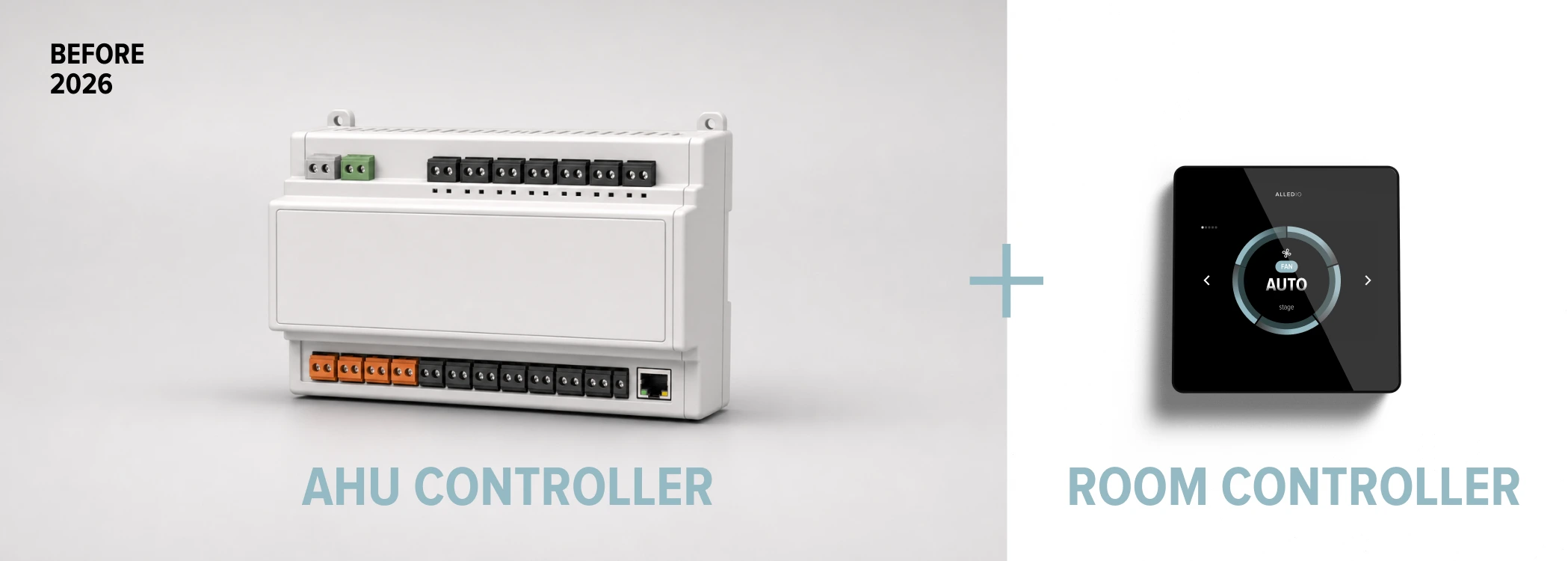
This is where the concept of an Alledio room controller or Alledio room thermostat replacing a controller in an AHU becomes not just logical, but inevitable.
The rise of the extended room controller
Modern room controllers are no longer simple thermostats. Devices like the Alledio room thermostat or Alledio room controller have evolved into high-performance processing units capable of handling complex thermodynamic calculations in real time.
The same flexible control platform can also be configured as an OEM room controller for fan coil units (FCUs).
We are talking about:
Advanced algorithms for heating, cooling, and air quality control,
Continuous processing of enthalpy, air density, and pressure conditions,
Integration of VOC, CO₂, humidity, and temperature data,
Real-time adjustments based on mass airflow and energy content.
In essence, what used to require a dedicated AHU controller can now be handled by a distributed, intelligent room-level system. The “brain” has moved closer to where decisions actually matter.
How a room controller can run an AHU
At first glance, it might sound counterintuitive. How can a room controller manage something as complex as an air handling unit?
The answer lies in processing power + smart architecture.
Modern controllers such as Alledio combine a powerful onboard processor capable of millisecond-level calculations with a wide range of universal inputs and outputs (I/O), additional power-output modules with digital outputs, and an internal Modbus communication bus connecting sensors and I/O modules.
An OEM room controller for AHU applications can directly manage heating valves, cooling valves, fans and airflow control, heat recovery systems and free cooling strategies. It is no longer just “controlling the room”—it is orchestrating the entire thermodynamic process of the AHU.
Sensors: the silent enablers of precision
The real magic happens through room sensor and HVAC sensor integration. A system built around the room controller replacing controller in AHU relies on a network of precise, interconnected sensors:
Room-level multi-probe sensors measure temperature and humidity
AHU-installed sensors track air conditions within the unit
Internal bus communication monitors air density and energy content
These sensors feed the controller with high-resolution, real-time data, allowing it to optimize heat recovery processes, adjust cooling strategies dynamically, and fine-tune airflow based on actual demand.
Think of it less like a static system and more like a living organism constantly adapting to its environment.
Advanced thermodynamics, simplified deployment
One of the strongest arguments for keeping traditional AHU controllers has always been their ability to handle complex thermodynamic algorithms.
That advantage is no longer exclusive.
The Alledio room controllers now incorporate: Enthalpy-based control logic, consideration of altitude and air pressure variations, real-time calculation of absolute humidity and energy content, optimization of mass airflow and heat exchange efficiency. All of this happens continuously, in milliseconds.
The result is more precise control than many legacy AHU systems, without the need for a bulky, centralized controller.
Efficiency gains that actually matter
Let’s talk outcomes.
By shifting to a room controller replacing controller in AHU approach, systems can achieve:
15–20% reduction in connected power
Even greater cost savings in actual energy consumption
Improved indoor air quality control
More stable and comfortable room conditions
- Much more inexpensive solution.
Why? Because the system reacts to real demand, not averaged assumptions. Instead of pushing conditioned air based on a generalized setpoint, it responds to live data from the space itself.
Installation: from complex to plug-and-play
Traditional AHU setups often involve extensive wiring, custom programming, and time-consuming commissioning.
This is where the new approach dramatically simplifies things.
With an extended room controller system:
Sensors and modules connect via an internal bus (Modbus), reducing wiring complexity
Software comes pre-configured for standard AHU setups
Adjustments are made through parameterization, not programming
The system supports plug-and-play deployment
For manufacturers and installers, this means less engineering time and fewer errors during commissioning, hence much faster installation. It is the difference between assembling a custom machine and snapping together a well-designed system that just works.
Built-in intelligence with clear visibility
Another overlooked advantage is the user interface.
Instead of relying on external systems, the controller includes:
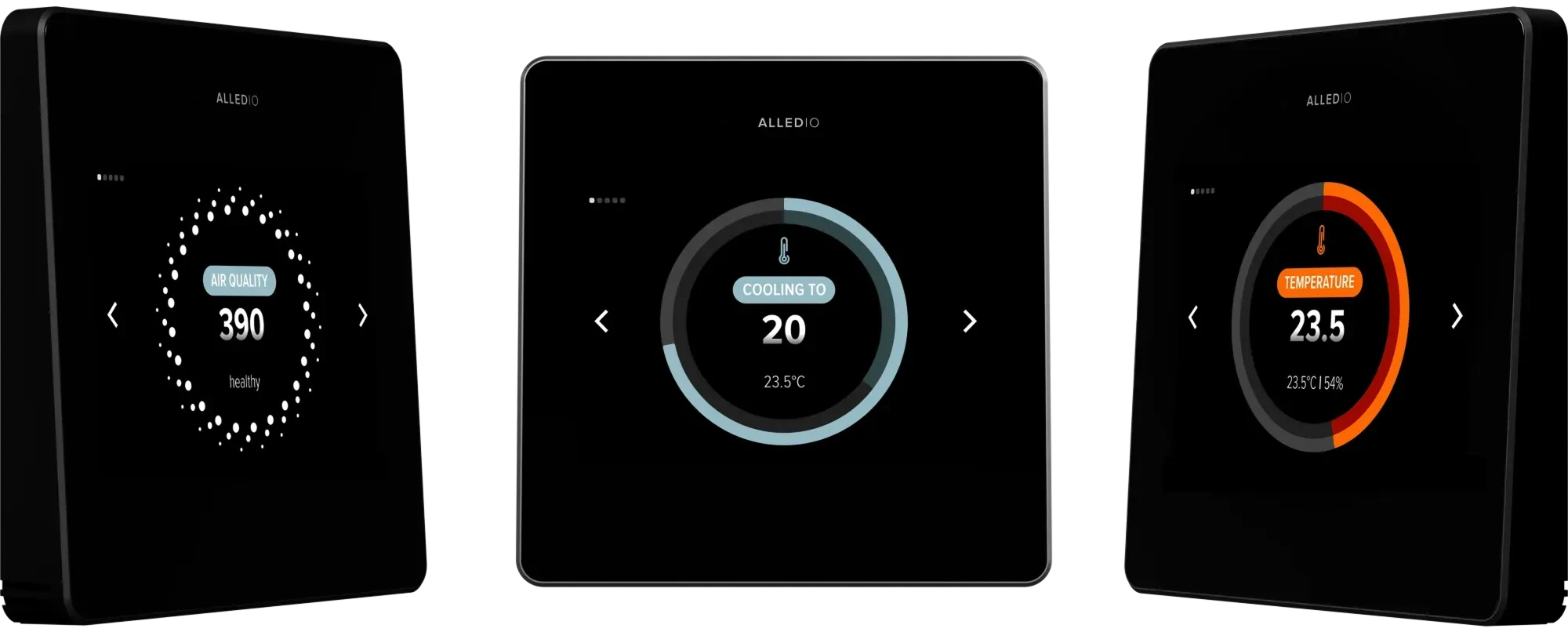
A graphical HMI (Human-Machine Interface)
A color display showing system schematics, and in the case of the flexible Alledio UI and adaptable room controller firmware anything that the HVAC manufacturer requires,
Real-time visualization of operating parameters
This allows operators to quickly understand system status, identify inefficiencies, adjust parameters without deep technical intervention. In short, it brings clarity to complexity.
A shift in system architecture
The move toward a room controller replacing the controller in an AHU is not just a product upgrade—it is a shift in building-automation architecture.
Instead of centralized intelligence, heavy infrastructure, and rigid system design, we now see distributed intelligence, lean architecture, and adaptive control at the edge. It is similar to how computing evolved from mainframes to distributed systems: smarter, faster, and more resilient.
When does this approach make the most sense?
This concept is particularly powerful for small commercial buildings, retail spaces, offices with multiple zones and Standardized AHU configurations.
The same room-level approach can also support rooftop HVAC equipment, as shown in our guide to room controllers for rooftop units.
In these environments, the traditional controller often becomes overkill, both technically and financially. A well-designed room controller system delivers everything needed—without the excess.
The real takeaway
The idea that every AHU needs a dedicated central controller is becoming outdated.
With modern processing power, integrated I/O, and advanced sensing, the room controller has evolved into a complete system manager.
The result?
Lower costs
Better performance
Simpler installation
Smarter energy use
And perhaps most importantly, a system that aligns with how buildings actually behave: from the room outward, not the plant inward.
A quiet revolution worth paying attention to
The transition to a room controller replacing the controller in an AHU will not happen overnight. But it is already gaining traction among forward-thinking manufacturers and system integrators.
Those who adopt it early can benefit from reduced system complexity, competitive cost advantages, and improved energy performance. If you are exploring ways to simplify AHU design while improving efficiency, this approach is worth a serious look. Or, to put it simply: if your “thermostat” can now run the entire system, it might be time to rethink what a controller really is.