If buildings could talk, most would probably complain about the temperature. But in the modern era of smart infrastructure, we don’t have to guess what a building is “feeling”—we have room units and sensors to tell us. These devices are the nervous system of any property, translating invisible data like temperature, humidity, and CO2 into actionable insights.
However, gathering data is no longer just a nice-to-have feature for high-end offices; it is becoming a regulatory necessity. European legislation is moving fast, transforming the way we design, renovate, and monitor our built environment. To navigate this landscape, industry professionals must understand the two pillars supporting this transition: the framework that defines the building’s potential, and the directive that mandates its actual consumption.
The Blueprint for Better Assets: The EPBD Explained
The Energy Performance of Buildings Directive (EPBD) is essentially the rulebook for the building itself. It focuses on the physical attributes of the structure—the insulation, the heating systems, the windows, and the automation capabilities. Its primary goal is to decarbonise the EU’s building stock by 2050, turning our homes and workplaces into Zero-Emission Buildings (ZEB).
The EPBD is where the technical specifications live. It mandates Energy Performance Certificates (EPCs), which act as a label for a building’s efficiency, much like the energy rating on a fridge. Recent revisions have pushed for stricter standards, aiming to phase out the worst-performing buildings first.
Key targets within the Energy Performance of Buildings Directive (EPBD)include:
Zero-Emission Standards: All new buildings must be zero-emission by 2030, while new public buildings must hit this target by 2028.
Renovation Passports: A roadmap for individual buildings to guide owners through a step-by-step renovation toward zero emissions.
Smart Readiness Indicator (SRI): A rating system that assesses a building’s capacity to use information and communication technologies to adapt to the needs of the occupant and the grid.
The Engine for Action: The EED Explained
If the EPBD is about the car’s engine design, the Energy Efficiency Directive (EED) is about how far you drive and how much fuel you actually burn. The EED establishes the overarching targets for reducing energy consumption across the entire European Union, not just in buildings, but including industry and transport.
The EED operates on the principle of “Energy Efficiency First.” This means that before investing in new energy supply (even renewables), we must first ensure we aren’t wasting the energy we already have. The directive sets binding targets to ensure the EU collectively reduces its energy consumption.
Key targets within the Energy Efficiency Directive (EED) include:
EU-Wide Reduction: A legally binding target to reduce EU final energy consumption by 11.7% by 2030 relative to previous projections.
Public Sector Leadership: The public sector is obligated to reduce its total final energy consumption by 1.9% each year.
Renovation Obligation: Public bodies must renovate at least 3% of the total floor area of their buildings annually to meet minimum energy performance requirements.

Comparing the Giants: A Quick Overview
To clarify the distinction, it helps to view them side-by-side. While they share a goal, their mechanisms differ.
| Feature | Energy Performance of Buildings Directive (EPBD) | Energy Efficiency Directive (EED) |
|---|---|---|
| Primary Focus | The physical building and its systems. | The actual energy consumption and savings. |
| Key Mechanism | Energy Performance Certificates (EPCs), Smart Readiness Indicator. | Binding reduction targets, energy audits. |
| Target Audience | Architects, engineers, construction, retrofitting. | Public authorities, energy companies, large enterprises. |
| End Goal | A decarbonised building stock (Zero Emission). | A reduction in total energy demand (Efficiency First). |
Where the Lines Blur: How EED and EPBD Overlap
While they are separate legal instruments, the Energy Performance of Buildings Directive (EPBD) and the Energy Efficiency Directive (EED) are inextricably linked. You cannot realistically meet the consumption targets of the EED without the structural renovations mandated by the EPBD. Conversely, the “Energy Efficiency First” principle of the EED drives the urgency for the deep retrofits outlined in the EPBD.
For stakeholders—whether you are a facility manager, a system integrator, or an investor—this overlap signals a shift toward holistic building management. It is no longer sufficient to simply swap out a boiler or install LED lights. The future roadmap requires an integration of active energy management (EED) with passive structural improvements (EPBD).
This convergence elevates the role of Building Management Systems (BMS). To prove compliance with EED savings targets, you need data. To achieve the smart readiness envisioned in the EPBD, you need connectivity. This means the roadmap for the next decade is paved with sensors, controllers, and interoperable software that can satisfy both directives simultaneously.
Beyond Static Settings: The “Cruise Control” of HVAC
Imagine driving a winding mountain road with your cruise control locked at a fixed speed, completely ignoring the curves, the steep drops, or the traffic ahead. That is essentially how a traditional heating curve works—it pushes heat based blindly on the outside temperature, ignoring the reality inside the building. Optimizing heating curves changes this by introducing a feedback loop from the room back to the plant.
Technically, this moves us from simple weather compensation to load-compensated supply temperature control. By aggregating real-time valve positions from room controllers, the system calculates the precise energy required to satisfy the “worst-performing” zone and automatically adjusts the boiler flow temperature down to the lowest efficient point. When we also layer in humidity data, we unlock enthalpy-based control. Because moist air holds more heat energy, maintaining optimal humidity allows us to slightly lower the dry-bulb temperature setpoint while maintaining the same perceived comfort. This dynamic calibration stops energy waste at the source and represents the sweet spot where compliance meets engineering excellence.
The Economic Opportunity: From Compliance to Value
Historically, regulation has been viewed as a cost—a hoop to jump through. However, viewing these directives solely as red tape misses the massive economic upside. The combined force of the EPBD and EED is creating a market where energy efficiency equals asset value.
Buildings that fall behind on EPBD ratings risk becoming “stranded assets”—properties that are too expensive to upgrade and legally impossible to rent out. On the flip side, early adopters who align with the Energy Efficiency Directive (EED) benefit from lower operational costs immediately.
The economic opportunity lies in future-proofing. By investing in high-quality room controllers and precise environmental monitoring now, owners protect the long-term value of the real estate. Furthermore, the push for renovation creates a massive demand for skilled integrators and smart technology, stimulating the construction and tech sectors alike.
The Energy Efficiency Opportunity: The Power of Precision
The greatest opportunity these directives present is the shift from “estimating” to “knowing.” In the past, energy efficiency was often calculated based on theoretical models. Today, with the push for digitalisation found in the Energy Performance of Buildings Directive (EPBD) and the strict reporting requirements of the Energy Efficiency Directive (EED), we are moving toward measured performance.

This is where the granular control of indoor climates becomes critical. Overheating a corridor by two degrees or ventilating an empty meeting room is no longer just a minor oversight; it is a measurable failure against your EED targets.
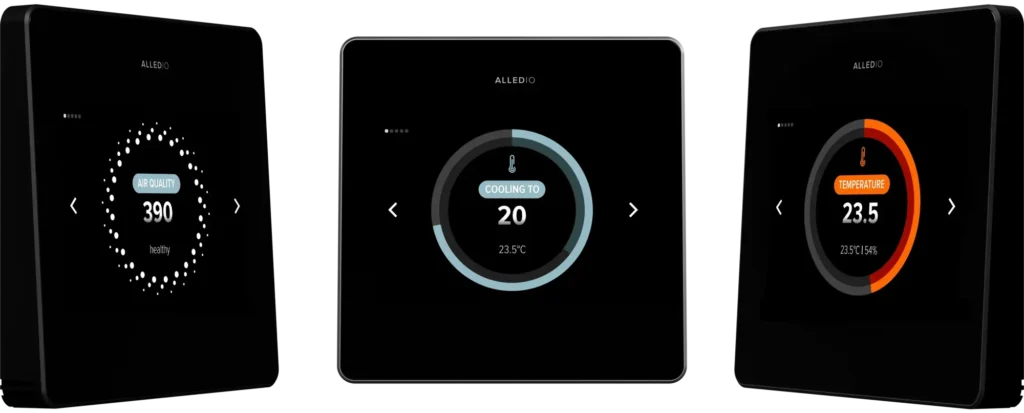
By utilizing advanced thermostats, room controllers and sensors that communicate via standard protocols like Modbus or BACnet, buildings can react in real-time. This dynamic adjustment—optimizing heating curves based on actual room occupancy and humidity levels—is the sweet spot where compliance meets engineering excellence. It turns the static concrete of a building into a responsive, living entity that actively works to save energy.