If fresh air is the lungs of a building, then a room controller for Variable Air Volume (VAV) units for fresh air supply is the brain quietly deciding how well those lungs perform. And like any good brain, the difference between average and exceptional lies in precision, adaptability, and just enough intelligence to make decisions without being noticed.
Modern buildings are no longer satisfied with simply moving air from point A to point B. They demand balance: comfort without waste, fresh air without inefficiency, and control without complexity. This is where the Alledio room controller steps in—less like a switch, more like a conductor guiding an orchestra of airflow.
Why VAV Systems Need Smarter Control
Variable Air Volume systems are designed for efficiency, but without proper control, they often fall short of their potential. A room controller for VAV fresh air systems ensures that airflow adapts in real time to what a space actually needs.
Instead of constant airflow regardless of occupancy, the system responds dynamically—delivering fresh air only when and where it is required. This not only improves comfort but also prevents unnecessary energy use. In essence, the VAV unit provides the capability, while the controller provides the intelligence.
Fresh Air Is No Longer Optional
Indoor air quality has become a central topic in building design, and for good reason. Poor ventilation directly impacts concentration, well-being, and even long-term health. A VAV room controller for fresh air supply plays a key role in maintaining the right balance. By regulating airflow based on factors like CO₂ levels, temperature, and occupancy, it ensures that spaces feel fresh without becoming energy-intensive. It also helps buildings meet increasingly strict air quality standards without overcompensating.
Introducing the Alledio Room Controller
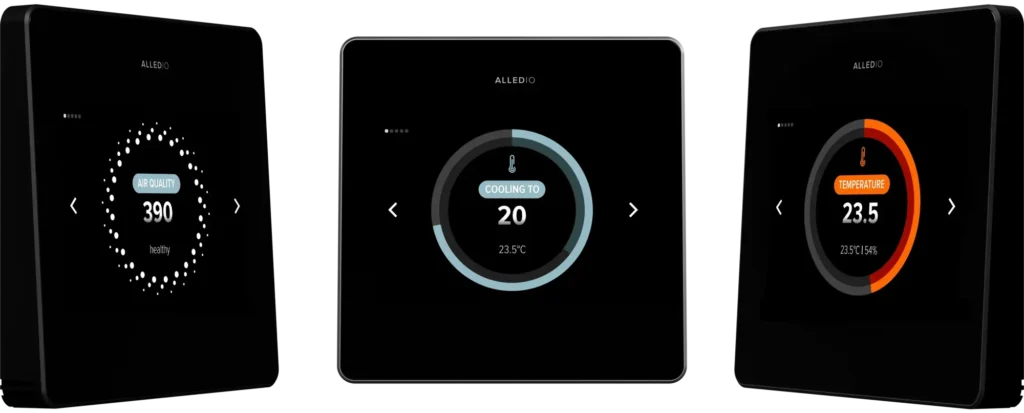
At the center of this approach is the Room controller, designed specifically to bring precision and adaptability to modern HVAC systems. Built for seamless integration with Variable Air Volume (VAV) units, it acts as the decision-making layer that continuously balances fresh air supply, comfort, and energy efficiency. Rather than relying on fixed settings, the controller dynamically adjusts to real-time conditions within the room, ensuring that ventilation is always aligned with actual demand. It is a solution that combines technical depth with practical usability, making advanced airflow control feel almost effortless.
From a technical perspective, the Allerdio Room Controller typically offers multiple universal inputs for temperature, CO₂, and occupancy sensors, along with configurable analog or digital outputs for controlling VAV damper actuators, fans, and valves. It communicates via industry-standard fieldbus protocols such as Modbus RTU over RS485 or Modbus TCP/IP, supports parameter configuration through a dedicated interface or touch panel, and can be powered from a low-voltage supply commonly used in building automation (for example 24 V AC/DC). Depending on the chosen version, it can be delivered with or without integrated CO₂ sensing, allowing it to fit both simple and advanced VAV fresh air control applications.
What Makes the Alledio Room Controller Different
The Alledio room controller is built to simplify complex HVAC behavior while delivering precise control behind the scenes. It continuously interprets data from the room and adjusts airflow accordingly, ensuring that conditions remain stable and efficient.
Its strength lies in adaptability. Whether integrated into a building management system or used as a standalone solution, it aligns airflow with actual demand rather than assumptions. The result is a system that feels responsive rather than rigid.
To complement this level of control, the system can be paired with a customizable interface like the Alledio OEM touch panel with custom firmware, which allows manufacturers and integrators to tailor the user experience to specific projects. This adds a layer of flexibility where control is not only intelligent in the background but also intuitive on the surface.
Outputs That Drive Precise VAV Control
A room controller for Variable Air Volume (VAV) units for fresh air supply is only as effective as its ability to translate decisions into action. This is where outputs play a crucial role. The controller manages damper actuators, fan speeds, and in some cases heating or cooling valves, ensuring that airflow is continuously adjusted to match real-time demand.
Instead of operating in fixed states, the system modulates outputs proportionally. This allows the VAV unit to deliver exactly the required airflow—no more, no less. The result is a smoother, quieter operation with fewer fluctuations, creating an indoor environment that feels stable rather than reactive.
Inputs That Make the System Intelligent
If outputs are the muscles, inputs are the senses. A VAV room controller relies on a combination of input signals to understand what is happening in the room at any given moment.
Typical inputs include temperature sensors, CO₂ levels, occupancy detection, and sometimes humidity. These data points form the foundation for demand-controlled ventilation. Instead of relying on assumptions or fixed schedules, the controller responds to actual conditions, ensuring that fresh air supply aligns with real usage patterns.
This constant feedback loop is what transforms a basic HVAC setup into a responsive and energy-efficient system.
Energy Efficiency Without Overthinking It
Energy savings in HVAC systems rarely come from one big change. Instead, they are the result of many small, intelligent adjustments happening continuously.
A room controller for Variable Air Volume (VAV) units for fresh air supply reduces energy consumption by avoiding over-ventilation and aligning airflow with real usage patterns. Over time, this translates into lower operating costs and reduced strain on central systems.
It is similar to dimming lights instead of turning them fully on all the time—subtle changes, meaningful impact.
Comfort That Feels Effortless

True comfort is not something occupants should have to think about. When airflow, temperature, and air quality are properly balanced, the environment simply feels right. The Alledio room controller helps maintain that balance by avoiding sudden fluctuations, drafts, or uneven ventilation. It creates a steady indoor climate where fresh air is present but never intrusive, supporting both productivity and well-being.
Flexible CO₂ Sensing Options
Not every project has the same requirements, which is why flexibility matters. A room controller for Variable Air Volume (VAV) units for fresh air supply can be delivered with integrated CO₂ sensing or without it, depending on the application.
For spaces where indoor air quality is a priority—such as offices, schools, or meeting rooms—CO₂-based control enables precise demand-driven ventilation. In simpler applications, the controller can operate without it while still maintaining reliable airflow control based on other inputs. This adaptability ensures that the solution fits both performance-driven and cost-sensitive projects without compromise.
Where This Solution Fits
A VAV room controller for fresh air supply is not limited to one type of building. It is equally effective in offices, schools, healthcare environments, hotels, and commercial spaces—anywhere airflow needs to adapt to changing conditions.
In all these environments, the controller acts as a quiet optimizer, ensuring that systems perform efficiently without constant human intervention.
For smaller air-handling applications, see how a room controller can replace a conventional AHU controller.
The Bigger Picture: Smarter Buildings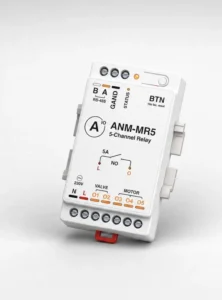
As buildings become more intelligent, the focus shifts from isolated components to connected systems that adapt in real time. A room controller for Variable Air Volume (VAV) units for fresh air supply plays a central role in that evolution.
The Alledio room controller represents this shift toward responsive environments where comfort and efficiency are no longer competing priorities.
For projects that require extended control capabilities, solutions like the 5-Channel Modbus Relay Extender provide additional flexibility and integration options within the same ecosystem.