There is a moment every product company eventually faces. The prototype works. The investor demo was a success. The market research says “go.” And then someone asks the question that has killed a thousand great ideas: “So… who’s going to actually build this thing?”
Finding the right OEM services supplier for electronics isn’t just a procurement decision—it’s arguably the most consequential strategic choice you’ll make before your first shipment. The wrong partner gives you a device that works in a lab. The right one gives you a device that works in the wild, at scale, under conditions nobody anticipated, shipped on time, and certified for the markets you care about.
This is exactly the gap Andivi was built to fill.
Hardware is Hard. Software Makes it Harder.
Let’s be honest about what makes electronics development genuinely difficult. It isn’t any single discipline—it’s the brutal intersection of all of them simultaneously.
Your PCB design has to account for signal integrity. Your firmware has to be lean enough to run on constrained hardware but robust enough to handle edge cases at 3 AM when nobody is watching. Your enclosure has to survive the environment it’s deployed in—whether that’s a boiler room, a server rack, or a consumer’s living room shelf. And all of this has to be done with components that are actually available, at a price point that makes business sense, with documentation clean enough to pass certification.
Miss any one of these threads, and the whole sweater unravels.
Andivi operates as a full-spectrum electronic hardware development company, covering the complete design stack from schematic capture and PCB layout through embedded firmware, mechanical enclosure design, and production handoff. The advantage of working with a team that holds all these disciplines under one roof is that the tradeoffs happen in conversation, not in conflict. A firmware constraint doesn’t arrive as a surprise three weeks before DVT; it informs the hardware design from day one.

Firmware: The Invisible Engine Inside Your Product
If hardware is the body, firmware is the nervous system—and a sluggish or unreliable nervous system makes the whole body useless, no matter how elegant the enclosure looks.
Andivi has deep expertise in two of the most widely deployed embedded platforms in the IoT and IIoT landscape: STM32 and ESP32. These aren’t just development boards you buy from a distributor—they are architecturally different platforms suited to different challenges. STM32 brings deterministic real-time performance, low power consumption, and industrial reliability. ESP32 brings integrated WiFi/Bluetooth, rapid prototyping speed, and a massive ecosystem. Knowing when to use which—and how to squeeze maximum performance from both—is the kind of expertise that doesn’t show up on a spec sheet but absolutely shows up in your product’s field performance.
For a detailed look at how Andivi navigates this platform decision and delivers production-grade firmware, read: From Idea to Production: Andivi’s STM32 and ESP32 Firmware Expertise That Delivers.

From Napkin to NRE: The OEM Journey Explained
Here’s a framework that most OEM discussions skip entirely: the difference between a product that works and a product that is ready to manufacture.
A prototype that works is a science experiment. A production-ready product is an engineering system with documented tolerances, tested failure modes, calibrated sensors, test fixtures, assembly instructions, and a bill of materials that won’t give your procurement team a nervous breakdown.
The bridge between these two states is Non-Recurring Engineering (NRE)—the focused investment of design and validation work that makes your device repeatable at scale. This is where Andivi specializes: not just building the first one, but engineering the process that builds the ten-thousandth one identically. For a transparent breakdown of how this works in practice, see: OEM Services & NRE: How Andivi Helps Turn Product Ideas into Production-Ready Hardware.
OEM for Consumer Electronics: Looks Matter as Much as Logic
IoT and IIoT aren’t the only arenas where Andivi operates. Consumer electronics accessories represent an entirely different set of design constraints—tighter cost targets, higher aesthetic expectations, and an end-user who will notice if the button feel is slightly off.
Developing consumer electronics under OEM terms requires a supplier who understands both the engineering rigor needed for reliability and the design sensitivity needed for shelf appeal. Cutting corners on either produces a product that either breaks or doesn’t sell. For consumer-focused projects, Andivi’s approach to OEM services for consumer electronics accessories covers the full design and production cycle with both factors in mind.
Private Label, European Standards
If you’re a company looking to bring a product to European markets under your own brand—without building an internal hardware team from scratch—private label manufacturing through an established OEM supplier is often the fastest and most capital-efficient route.
But not all OEM partners are equal when it comes to European compliance. CE marking, EMC testing, RoHS, and REACH aren’t bureaucratic formalities; they are genuine engineering requirements that must be addressed at the design stage, not bolted on at the end. Andivi’s grounding in European standards means these compliance pathways are built into the design process, not treated as a last-minute checklist. For companies targeting European distribution, this distinction is worth a significant amount of time and money saved. For a full overview of how this works: OEM Services for Private Label Manufacturing Europe.
Products That Prove the Point
Abstract claims about capability are easy to make. Products in the field are harder to fake.
The BACnet Multi-Sensor ANB-THPVCP is a real-world demonstration of what Andivi’s OEM engineering looks like at a system level. Packing temperature, humidity, pressure, VOC, and CO2 sensing into a single, BACnet-certified unit—deployable in building automation and HVAC environments—requires not just sensor integration, but deep protocol expertise, enclosure design for wall-mount deployment, and firmware that communicates reliably on a shared BACnet network. This is not a hobbyist project; it is a production device operating in professional infrastructure.
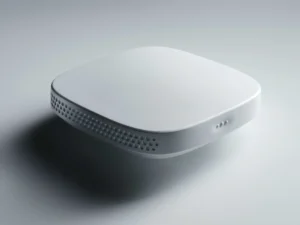
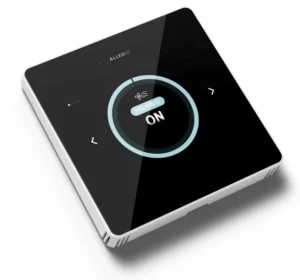
Similarly, the OEM Room Controller Alledio demonstrates Andivi’s ability to design a device that is simultaneously a sophisticated engineering achievement and a genuinely user-friendly product. A 480×320 touchscreen, multi-protocol connectivity (WiFi, Bluetooth, Modbus, BACnet, MQTT), multiple onboard sensors, and a glass-panel industrial design that looks like it belongs in a premium architectural fit-out. That combination does not happen by accident—it happens because the hardware, firmware, and UX decisions were made together, with a clear picture of who the end user is and what environment they’re operating in.
Andivi’s Real Differentiator: Thinking Like Your Business, Not Just Your Engineer
Most electronics R&D companies think in components. Andivi thinks in products.
The distinction sounds subtle, but it changes everything about how a project runs. User-centric design isn’t just a UX principle for apps—it’s a hardware discipline. It means understanding that the person installing your device at 6 AM on a cold building site has different needs than the facility manager reviewing data on a dashboard. It means designing both experiences intentionally.
This business-aware approach is what makes Andivi genuinely agile as an OEM partner. When market feedback suggests a pivot—add a different sensor, swap a communication protocol, redesign the mounting bracket—a team that understands the business reason behind the change executes it faster and with fewer misinterpretations than a team that is simply executing a spec sheet.
If your hardware idea has been sitting at “almost ready” for longer than it should, or if you’re evaluating OEM partners for your next electronics project, Andivi is worth a conversation. Not because of a sales pitch, but because the work speaks clearly enough on its own.