Everyone loves to talk about enthalpy-based control because it sounds clever and advanced – and it is. But behind every good enthalpy calculation in an AHU, there’s a much quieter hero: inlet temperature.
Think of inlet temperature as the opening scene of a movie. If that first frame is wrong, the entire story – coil performance, free cooling, energy savings – starts off on the wrong foot.
In this article, we’ll unpack why inlet temperature matters so much, how it ties directly into enthalpy in AHUs, and where it fits in smarter control strategies and sensor design.
What exactly is inlet temperature in an AHU?
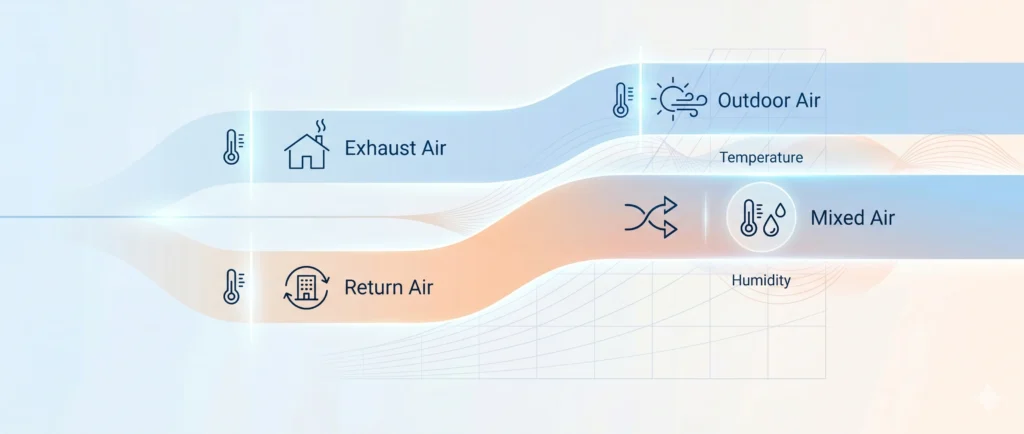
In an AHU context, inlet temperature usually refers to the temperature of the air as it enters a specific section of the unit:
Outdoor air entering the AHU
Return air entering the mixing section
Mixed air entering the cooling coil (often called coil entering air temperature)
Every one of these inlet temperatures feeds directly into the enthalpy of that airstream, because enthalpy is a function of:
Dry-bulb temperature
Moisture content / relative humidity
You can’t talk about enthalpy in AHUs without talking about inlet temperature. It’s one of the two key ingredients in the total energy “recipe” of the air.
If you want a broader, total-energy view of this concept first, it’s worth reading: Enthalpy-Based Control in AHUs: Thinking in Total Energy
Inlet temperature as the visible part of enthalpy
In practice, engineers and facility managers often see temperature as the “visible” value and enthalpy as the “calculated” or “invisible” one.
You can think of it like this:
Inlet temperature = the part your thermometer tells you
Enthalpy = inlet temperature + hidden moisture energy your coil and compressor will eventually pay for
For outdoor, return and mixed air, you always start from inlet temperature measurements, then add humidity to get enthalpy:
So when your AHU decides whether to use free cooling or mechanical cooling, it is effectively comparing:
Outdoor inlet temperature + humidity
vs.Indoor (return) inlet temperature + humidity
That’s enthalpy-based control in disguise.
For a deep dive into how this plays out in free cooling, this article is an excellent follow-up: The Importance of Enthalpy in Free Cooling for AHUs
Why inlet temperature sets the stage for coil performance
The cooling coil doesn’t directly care about your weather app. It cares about the conditions of the air entering it – the coil inlet temperature and humidity.
Those entering conditions determine:
How big the enthalpy drop across the coil has to be
How much of that is sensible cooling (temperature drop)
How much is latent cooling (dehumidification)
Higher inlet temperature (with significant moisture) = higher entering enthalpy = more load on the coil and chiller.
This is where inlet temperature and enthalpy are inseparable:
If your mixed air inlet temperature is too high, even good enthalpy logic can’t save you – the coil still has to do more work.
If inlet conditions are well managed (smart mixing, correct damper positions, proper free cooling decisions), the coil sees lower entering enthalpy and your compressor breathes a sigh of relief.
In other words: enthalpy-based control makes sure the mixed air that reaches the coil has the lowest reasonable inlet temperature and moisture for that moment, without sacrificing indoor comfort.
Inlet temperature and free cooling decisions
Most economizer or free cooling strategies historically started with a simple rule:
“If outdoor inlet temperature is lower than indoor temperature, open the outdoor damper.”
The problem is obvious in humid climates: cool-but-damp air slips through this simple rule and turns your “free cooling” into coil-heavy dehumidification.
Modern strategies upgrade this to:
Use inlet temperature as a first sanity check.
Use enthalpy (inlet temperature + humidity) as the real decision-maker.
So the AHU logic becomes more like:
“Is outdoor inlet temperature lower than indoor?”
“And, more importantly, is outdoor enthalpy actually lower than return-air enthalpy?”
This mixed approach gives you the best of both worlds:
Temperature for intuitive, easy-to-understand thresholds
Enthalpy for accurate energy-based decisions
If you’re interested in how this all ties into handling cooling and waste heat in AHUs, this article explores those interactions in a practical context: Cooling and Handling Waste Heat in AHUs with Enthalpy.
A quick table: inlet temperature vs enthalpy in AHU decisions
To make the role of inlet temperature crystal clear, here’s a compact comparison:
The punchline: inlet temperature is the front door; enthalpy is the full home inspection. You need both for serious AHU optimization.
Inlet temperature, sensors and smart devices
Because inlet temperature is one of the primary inputs to enthalpy, sensor strategy matters a lot:
You usually measure inlet temperature and humidity at:
Outdoor air inlet
Return air inlet
Mixed air (before the coil)
These measurements feed enthalpy calculation in your controller, BMS, or sensor firmware.
This is where multi-sensor devices shine: they can measure temperature, humidity and calculate enthalpy at the inlet points where decisions are made.
For OEMs or integrators that want enthalpy-ready signals (for AHUs, rooftop units, or custom air systems), this kind of modular sensor platform is exactly the kind of component that simplifies design: Multi-Sensor OEM Platform with BACnet / Modbus (including Enthalpy)
And if you prefer a ready-to-use, field-oriented sensor focused specifically on enthalpy with Modbus, this is a nice practical option for capturing inlet conditions as total energy: Modbus Enthalpy Sensor

Why inlet temperature deserves its own spotlight
So, why a whole article on inlet temperature when enthalpy is the supposed star?
Because in real projects:
Inlet temperature is the value everyone looks at first.
It anchors your understanding of what the AHU is facing at any given moment.
It’s the basis for almost all legacy strategies – which makes it the natural bridge toward enthalpy-based control.
When you explain enthalpy to teams or clients, starting from inlet temperature is often the easiest way in:
“We already monitor inlet temperature. Now we’re adding humidity and turning that into a more honest energy metric – enthalpy – so the AHU can choose the cheapest air to treat.”
From there, it’s a small conceptual step to the bigger picture of total energy control, like in: Enthalpy-Based Control in AHUs: Thinking in Total Energy
Turning inlet temperature into smarter projects
If you’re upgrading existing AHUs and economizers, Designing new AHUs with enthalpy-based control from day one, or in need of HVAC-focused IoT / IIoT hardware and software then inlet temperature is more than just a number on a trend log. It’s the anchor point of every enthalpy calculation and every energy decision the AHU makes.
Treat it as such: Place your inlet sensors thoughtfully, Combine temperature with humidity and enthalpy in your logic. Use inlet temperature as the “visible” metric to explain decisions, and enthalpy as the “intelligent” metric to drive them.