BACnet IP vs MS/TP vs EnOcean – in building automation, BACnet and EnOcean are not rivals so much as complementary characters. BACnet/IP and BACnet MS/TP are the structured, backbone languages of the building, while EnOcean is the discreet, wireless whisper at room level. Understanding how these protocols differ – and how they fit together – is key to designing a resilient, flexible, and modern building automation system.
BACnet/IP, BACnet MS/TP and EnOcean in Plain Language
BACnet (Building Automation and Control Network) is an open standard designed specifically for building automation and control. Two transport variants dominate: BACnet/IP and BACnet MS/TP. Both share the same data model (BACnet objects, properties, services), but they travel over different physical and network layers (for e.g. BACnet Sensors).
EnOcean, in contrast, is a wireless protocol designed for ultra‑low‑power and energy‑harvesting devices. Many EnOcean devices power themselves from motion, light, or small temperature differences. This makes them ideal for battery‑free sensors and switches in offices, retrofits, and dynamic spaces where running cables to every point is impractical or too expensive.
BACnet/IP vs BACnet MS/TP vs EnOcean at a Glance
The three technologies sit at different layers of the building automation stack. BACnet/IP is the fast, IP‑based backbone; BACnet MS/TP is the cost‑effective bus for local networks; EnOcean is the wireless edge for room devices.
| Aspect | BACnet/IP | BACnet MS/TP | EnOcean |
|---|---|---|---|
| Primary role | High‑speed backbone for building automation over IP networks | Local field bus for controllers and devices on RS‑485 | Wireless edge for room‑level sensors and switches |
| Medium | Ethernet, IP (UDP) | RS‑485 serial bus | Sub‑GHz radio |
| Topology | Switched star/tree IP networks | Daisy‑chain / bus topology | Star‑like wireless network via gateways and repeaters |
| Typical devices | Supervisory controllers, routers, large plant controllers, BMS servers, in-door BACNet sensors | Room Sensors for Building Automation, Floor/zone controllers, field I/O, smaller plant devices | Room sensors, wall switches, window/door contacts, occupancy sensors |
| Power concept | Externally powered | Externally powered | Often energy‑harvesting, battery‑free |
| Best fit | Large sites, campuses, IT‑integrated systems, future‑ready networks | Small/medium buildings, localized networks, cost‑sensitive segments | Retrofits, flexible offices, heritage buildings, “no‑cable” zones |

How BACnet/IP Fits into the Building
BACnet/IP uses standard Ethernet and IP networking, which means it can run on the same structured cabling and switching infrastructure that serves IT systems. This gives it several clear strengths. It supports high bandwidth and large device counts, making it suitable for campuses, large towers, hospitals, airports, and distributed portfolios.
Because it uses IP, BACnet/IP plays well with modern tools, diagnostics, and cybersecurity concepts. Network monitoring, VLANs, routing, VPNs, and firewalls can all be used to shape and protect traffic. This is particularly valuable when building automation data needs to leave the building’s local network, for example for remote supervision or cloud analytics. In short, BACnet/IP is the natural choice for the backbone layer where performance and scalability matter.
Where BACnet MS/TP Still Makes Sense
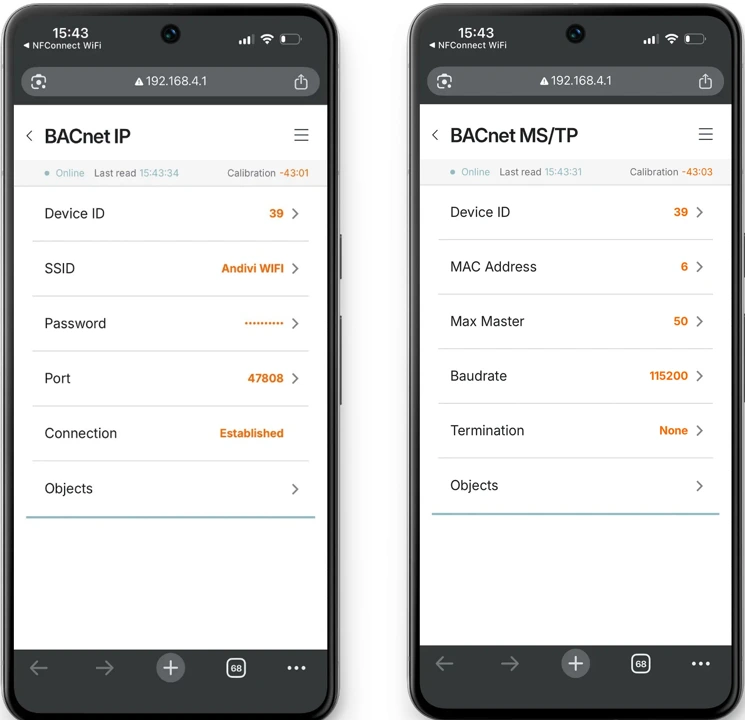
BACnet MS/TP (Master‑Slave/Token‑Passing) runs on RS‑485 twisted‑pair cabling. Devices share a common bus and take turns communicating, coordinated by a token‑passing mechanism. It is slower and less scalable than BACnet/IP, but it brings advantages of its own.
First, RS‑485 is simple and cost‑effective. A single cable can be daisy‑chained between multiple devices, which reduces material and installation costs in small to medium buildings or localized zones. Second, MS/TP networks are inherently local and isolated. They do not naturally “spill over” into the IT world, which can reduce cybersecurity exposure if the bus remains physically confined to plant rooms and electrical closets.
In many projects, BACnet MS/TP is used to connect floor controllers, fan‑coils, VAVs, or small plant devices, which then concentrate data up to BACnet/IP at the supervisory level. This hybrid approach aligns cost and performance with actual needs: IP where scale and speed are required, MS/TP where a simple shared bus will do.
EnOcean at the Room Edge
While the BACnet variants handle wired communication between controllers and systems, EnOcean focuses on the wireless edge. EnOcean devices shine where installing new cabling is either disruptive or prohibitively expensive.
A typical EnOcean deployment features battery‑free wall switches, occupancy sensors, temperature sensors, and window or door contacts. These devices gather just enough energy from their environment – a button press, indoor light, or a small temperature gradient – to send compact radio telegrams. A gateway receives these telegrams and maps them into BACnet points, so the BMS can treat them like any other sensor.
The result is a system where room‑level devices can be moved, added, or reconfigured with minimal disruption. Need to rezone an office floor or transform a meeting room into collaboration space? EnOcean devices can shift with the furniture, while BACnet/IP and BACnet MS/TP wiring remain untouched in the background.
Installation and Commissioning: Cables vs Radio
From an installation perspective, each technology has distinct implications.
BACnet/IP relies on structured IP networking: Ethernet cables, switches, and often collaboration with IT teams. This infrastructure may already be present in modern buildings, which makes BACnet/IP highly attractive. However, it also requires adherence to IP addressing, segmentation, and security policies, which adds design and commissioning effort.
BACnet MS/TP, by contrast, is a simple two‑wire bus. Devices are addressed logically, and installers daisy‑chain them along the RS‑485 trunk. This keeps material and topology straightforward, but it demands good practices: correct termination, respect for segment length, and careful attention to bus loading and grounding. A single mis‑wired or failing device can disrupt several others on the same chain.
EnOcean sidesteps both power and communication wires at the field device. Installation often reduces to mounting the device and teaching it into a gateway or controller. This speeds up tenant fit‑outs and retrofits significantly. However, RF planning takes over as the key skill: ensuring that sensors are within range, not heavily shielded by metal or concrete, and that the number of devices per gateway is reasonable for the desired performance.
Data Models and Behaviour
BACnet/IP and BACnet MS/TP share the same BACnet object model. Every sensor reading, output command, schedule, alarm, or trend is represented as an object with properties such as present value, units, limits, priorities, and alarm states. This provides a rich and structured view of the building that supervisory software can interpret and visualise consistently, regardless of device manufacturer.
EnOcean messages are much more compact. Each transmission carries a small set of bits representing a state or value – for example, a rocker switch being pressed, a contact opening, or a temperature reading. Gateways interpret this payload and translate it into the equivalent BACnet object. This mapping layer is crucial: it turns minimal, energy‑efficient radio telegrams into fully fledged points in the BACnet universe.
In practice, the building management system may not “know” which protocol was used at the edge. It simply sees a BACnet point. The distinction lies in how that point is physically realised: wired via BACnet/IP or BACnet MS/TP, or wirelessly via EnOcean.
Reliability, Security and Limitations
Each technology comes with its own strengths and caveats.
BACnet/IP can deliver fast, scalable, and flexible communication, but because it operates on IP networks, it must be treated like any other critical network service. Proper segmentation, firewalling, and secure remote access are essential to prevent unauthorised access or accidental interference. Misconfiguration at the network layer can affect whole segments of a BACnet/IP system.
BACnet MS/TP tends to be more contained, as RS‑485 buses are physically limited to a building or a part of it. However, MS/TP is slower and more sensitive to wiring issues. A poorly terminated or faulty device can clog the token‑passing process, leading to sluggish or unstable communication. Troubleshooting sometimes requires visiting devices one by one along the bus.
EnOcean’s wireless nature brings freedom from cables, but also sensitivity to radio conditions. Thick walls, metal, or dense structures can block or weaken signals. As a low‑power system, EnOcean is not designed for large data volumes or high message frequencies; it is optimised for small, event‑based messages. Furthermore, energy‑harvesting devices depend on having adequate environmental energy – low light levels or little motion can impose constraints on placement and behaviour.
Typical Use Cases and Adoption
BACnet/IPis a natural fit for large and complex buildings, multi‑building sites, and environments where building automation must integrate closely with IT and cloud services. It is widely used for main controllers, integration panels, and supervisory servers, serving as the central nervous system of the building.
BACnet MS/TPis common in small to medium buildings and as a local field bus in subsystems. It is frequently chosen where cost and simplicity are more important than speed, and where device counts per segment remain modest. Controllers often expose BACnet/IP upstream while communicating with local field devices via BACnet MS/TP.
EnOcean has found strong traction in offices, retrofits, tenant improvements, modular buildings, and heritage projects, where minimal disruption is a priority. Wireless, battery‑free EnOcean sensors and switches are especially attractive where plans change frequently or where visible wiring is undesirable.
Future Outlook: Hybrid Architectures by Design
The future of building automation is not about choosing a single “winner” but about composing the right mix. BACnet/IP is likely to remain the dominant backbone for larger and more connected facilities. BACnet MS/TP will continue to serve as a cost‑effective, local bus for field devices where its limitations are acceptable.
EnOcean will increasingly occupy the agile, occupant‑facing edge, providing flexible, low‑maintenance sensing and control in rooms and zones. By consciously designing systems where BACnet/IP, BACnet MS/TP, and EnOcean each operate at their natural layer, engineers can create buildings that are easier to extend, secure, and adapt – even as their use and occupancy patterns evolve over time.