Sensors for data collection are the difference between a system that seems under control and one that actually is. In buildings, industry, and especially high-stakes environments like data centers, the quality of decisions depends on the quality of measurements—and that starts with choosing the right sensors and integrating them properly.
Andivi’s Modbus and BACnet sensor lines are designed for exactly this reality: structured, interoperable sensors for data collection that fit into the ecosystems where data is gathered, logged, alarmed, and acted upon.
Choosing Sensors for Data Collection (Before You Choose Regrets)
Selecting sensors for data collection is less about ticking feature boxes and more about avoiding the hidden traps that show up after commissioning. A sensor can look perfect on paper and still fail in the field if the application context is ignored.
Here’s what matters most:
What needs measuring (and why)
Start with the operational objective: energy efficiency, comfort, compliance, uptime, predictive maintenance. Then map the measurements to that goal—temperature, humidity, CO₂, VOC, PM2.5, pressure, and presence are common building blocks for meaningful data collection.Where and how it’s installed
A sensor mounted poorly becomes a very precise reporter of the wrong reality. For example, wall sensors placed near heat sources or in dead-air corners skew data. Duct sensors installed without proper airflow conditions can underrepresent real supply air values. Great sensors for data collection still need correct placement to tell the truth.Output and protocol fit
For modern systems, protocol choice is a major design decision. BACnet typically feels at home in building automation ecosystems, while Modbus is widely used across industrial and SCADA-centric environments. If your infrastructure speaks a specific “language,” your sensors for data collection should be fluent in it.Stability and lifecycle
Data collection is not a one-week commissioning party—it’s a long-term relationship. Choose sensors designed for low drift, stable operation, and maintainable calibration strategies. Otherwise, your trend lines slowly become fiction.
Accuracy vs. Precision: Why Data Collection Needs Both
Accuracy and precision are often used interchangeably, but in sensors for data collection, they solve different problems:
Accuracy answers: “How close is the reading to the real value?”
Precision answers: “How consistently does the sensor repeat the same reading?”
A sensor can be very precise (repeatable) and still inaccurate (consistently wrong). That’s dangerous in automation because the system will confidently act on incorrect data. On the flip side, a sensor can be accurate on average but imprecise, producing noisy data that causes unstable control behavior and false alarms.
For sensors for data collection, the goal is dependable signal quality:
Accuracy supports correct decisions (e.g., correct cooling response).
Precision supports stable decisions (e.g., no oscillation, no jittery control loops).
In practice, reliable control and analytics require both—especially when multiple systems depend on the same measured truth.
Integrating Sensors for Data Collection into BMS / SCADA
Integration is where sensors for data collection move from “installed devices” to “useful infrastructure.” A great sensor that isn’t integrated cleanly becomes a silent ornament.
A practical integration approach includes:
Consistent naming and tagging
Define a naming convention that includes location + system + variable (e.g., “AHU1_SupplyTemp” or “Floor2_East_CO2”). This saves time during commissioning and prevents confusion years later.Correct units and scaling
Ensure BMS / SCADA interprets each value correctly (°C vs °F, ppm vs %, Pa vs kPa). Mis-scaling is one of the fastest ways to sabotage data collection while everything looks “connected.”Polling rates that match reality
Not every value needs a second-by-second update. Logging too frequently floods storage and adds noise; logging too slowly hides anomalies. Tune your sampling rates based on how fast the variable changes and how quickly you need to react.Health monitoring
Good systems don’t just monitor temperature—they monitor whether the sensor is alive. Add communications-loss alarms and plausibility checks so you know when data collection becomes unreliable.
Data Centers: The Most Honest Use Case for Sensors for Data Collection
If buildings are complex, data centers are unforgiving. They don’t reward optimism; they reward measurement.
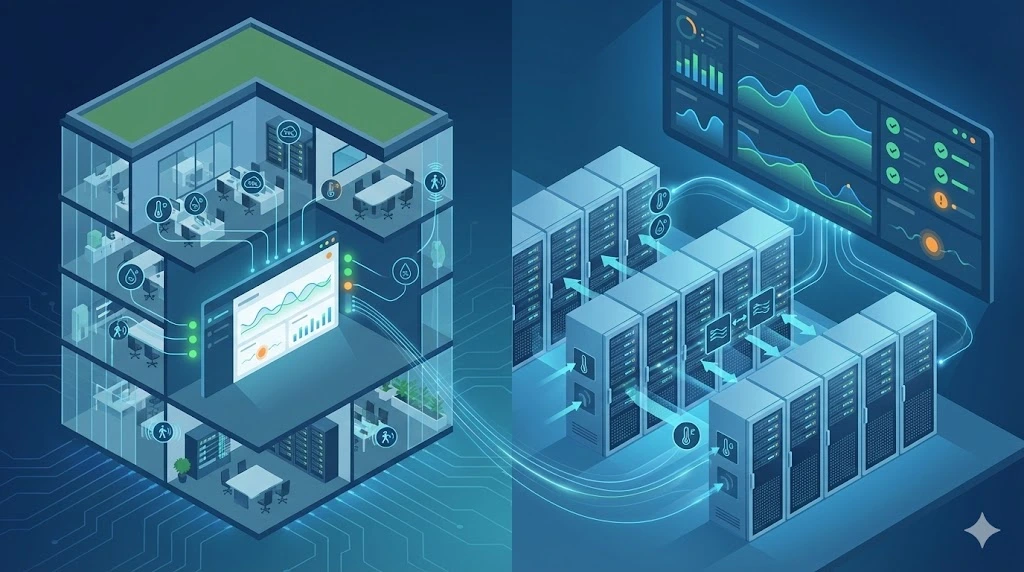
Sensors for Data centers make a strong case for for data collection because:
Cooling and airflow strategies depend on tight environmental control.
Small deviations scale into large energy costs.
Hot spots can form locally even when “average” room temperature looks fine.
Alarms and trend analysis are essential for preventing downtime.
Typical data collection focus areas include:
Rack inlet temperatures (not just room averages).
Humidity control to reduce risk of ESD (electrostatic discharge) or condensation.
Pressure differentials to validate airflow management.
Air quality where filtration and contamination control matter.
In these environments, sensors aren’t accessories; they’re the foundation of operational certainty.

AI and Sensors for Data Collection: When Data Stops Being Passive
AI isn’t magic—it’s math with ambition. And it only works well when fed with good, consistent data. That’s why sensors for data collection are the real enablers of AI use cases.
A few grounded examples:
Predictive maintenance
AI models can learn “normal” patterns in temperature, humidity, and pressure behavior. When fans degrade, filters clog, or dampers drift, the system can flag anomalies before failures become visible.Energy optimization
AI can correlate occupancy (presence), air quality (CO₂/VOC), and thermal data to adjust ventilation and setpoints dynamically—reducing energy use without compromising comfort or compliance.Anomaly clustering
Instead of a simple threshold alarm (“CO₂ high”), AI can detect multi-variable patterns (“CO₂ rising + airflow dropping + pressure shifting”) to pinpoint root causes more accurately.Cross-site benchmarking
For multi-building portfolios, AI can compare similar zones across sites and detect outliers—useful for standardizing performance and identifying inefficient assets.
A good rule: the more advanced the analytics, the more it depends on dependable sensors for data collection. AI doesn’t replace sensing; it amplifies it.
Practical Alarm Strategy: Turning Data Into Action
Data collection without alarms is like installing smoke detectors that only record smoke history. Effective sensors for data collection should feed a system that can react.
A practical alarm framework includes:
Threshold alarms for safety and compliance limits.
Delay timers to avoid nuisance alarms from short spikes.
Rate-of-change alarms to catch fast failures early.
Plausibility rules (compare related sensors) to detect sensor faults.
Alarm prioritization so operators focus on what truly matters.
The goal is fewer alarms with more meaning—because alarm fatigue is a real operational risk.
Find Out More
If the goal is dependable sensors for data collection across buildings, industry, and critical infrastructure, Andivi’s Modbus and BACnet sensor families are built to integrate cleanly into BMS and SCADA environments and support structured long-term data strategies.
Find out more about Andivi Modbus and BACnet Sensors and request samples you’d like to test or meet us at the MCE Fair in Milan this March and talk with our team.